
Art in the Age of the Uncanny
Christopher Lawton
Msc Media Arts & Imaging: 3d Computer Animation
2010 Dissertation
Duncan of Jordanstone College of Art & Design
Christopher Lawton
Msc Media Arts & Imaging: 3d Computer Animation
2010 Dissertation
Duncan of Jordanstone College of Art & Design
Abstract
This study seeks to examine the phenomenon of the Uncanny, and how it relates to artistic practice. It will show how the Uncanny has an evolutionary tie to humanity1, and how this relationship has greatly influenced art since the Enlightenment2. This study will also explore the Uncanny nature of technology, such as photography, film, and computer graphics. In doing so, it hopes to provoke further thinking on the topic through discussion of some of the subtle ways the Uncanny impacts on contemporary culture.
1 Jentsch, E. 1906 (in Jentsch, E. 1997).
2 Royle, N. 2003.
1 Jentsch, E. 1906 (in Jentsch, E. 1997).
2 Royle, N. 2003.
Introduction
In 2001, on the 11th of September, at 8.45am Eastern Daylight Time, the world entered a new age. A passenger jet crashed headlong into the North Tower of the World Trade Center. A tragic accident, until 18 minutes later repetition brought revelation, as another passenger jet hit the South Tower3. The attack on the World Trade Center echoed around the world, its Uncanny horror attaining resonance with each repetition of the strike and collapse of its towers4.
Bearing witness to the first broadcast of those attacks, and the many echoes recurring in the aftermath on that day, one could not grasp or guess at the fallout the event would have. The only overriding thought witnessing the repeated video, and hearing the repeated sounds of the dead and the dying, was that this was an apocalyptic event. This youthful, naïve interpretation of these ghastly events as they continued to unfold in fresh perspectives and footage held a grain of truth.
Apocalypse, which is taken by many as a simple term meaning the end of the world actually means a revelation, an illumination5. It signals the end of an era, death to a particular way of thinking or world view, and the birth of another. In this, the World Trade Centre attack truly was an apocalyptic event, taking the world on a new tangent, into a new age. The age of the Uncanny.
The Uncanny has been a part of human nature since primitive man6. Gaining resonance and a foothold in the creative and curious mind since the age of Enlightenment7, the Uncanny has helped shape the evolution of art and creativity in the same way it has helped shape human evolution. It is now thought that the Uncanny holds the key to the future of human development and the study of human feeling8.
This study seeks to explore the relationship that the Uncanny holds with human thought and human evolution. It will also explore the relationship that the Uncanny holds with technology and the Arts. Overall, this study intends to explore the importance of the Uncanny to contemporary creativity, and how it can be used in the creation of art.
3 CNN Archives: http://archives.cnn.com/2001/
US/09/11/chronology.attack/
4 Royle, N. 2003. Preface.
5 Gray, J. 2007.
6 Freud, S. 1919 (in Freud, S. 2003).
7 Royle, N. 2003. Page 8.
8 Royle, N. 2003. Page 23.
3 CNN Archives: http://archives.cnn.com/2001/US/09/11/chronology.attack/
4 Royle, N. 2003. Preface.
5 Gray, J. 2007.
6 Freud, S. 1919 (in Freud, S. 2003).
7 Royle, N. 2003. Page 8.
8 Royle, N. 2003. Page 23.
The Uncanny Phenomenon
The Uncanny phenomenon impacts immensely upon contemporary culture and life. It has been shown to be a fundamental part of human nature, key to our evolution and survival9. From at least the Age of Enlightenment10, the Uncanny has influenced all forms of narrative art. Brought into intellectual discussion in the contemporary world by Ernst Jentsch11 and Sigmund Freud12, research into the Uncanny has expanded into computer science and robotics13, psychological analysis, art14 and culture15. All this grew from its origins in psychoanalytic study of language, literature, dreams and reality.
To Jentsch, the Uncanny was a phenomenon of the uncertainty of intellect16. Jentsch thought the Uncanny was caused by Misoneism17. Thinking that humanity deciphers external reality through internalization and interpretation, based upon internal reality and perception, he argued that the Uncanny could have given rise to the notion of Demons18. Through internalization, fear objects could become tied to the self19.
The Uncanny appears, to Jentsch, to be an evolutionary device designed to protect mankind and help secure a position as the dominant predator in nature20. Through avoidance of what Freud came to term the unpleasureable21, the Uncanny defence mechanism stimulates learning and progress.
Freud’s later interpretation found the Uncanny far more complex than his predecessor22. Traversing beyond the intellectual uncertainty argument, Freud speculated that primitive, pre-civilized man held the roots of the Uncanny. To him, it was the return of the repressed23. The Uncanny24 circumnavigates a vast ocean of possibility and theory. It continues to inspire further thought and analysis with each new read through. In this it is a unique and Uncanny text25.
Originally discussed and explored throughout Academe and literature, Freud’s legacy birthed the Uncanny Narrative Tropes26, which now permeate all narrative art forms. Individual in-depth analysis of these tropes is outside the scope of this study. Instead, holistic discussion will highlight specific Uncanny elements and influences.
Humanity contains within itself an Uncanny urge for oblivion, a Death Drive27. The Death Drive is the antithesis of the evolutionary urge to procreate and construct. These traits, humanized in ancient storytelling through the godly personifications of Eros and Thanatos are, according to Royle, the instinctual impulses of Sex and Death28. To Freud, both drives were symbiotic, co-dependant, permeating all human thought and action29. D.H. Lawrence discussed humanity’s reluctance to admit a desire for death, instead acting in self deception of desire for life30 In this manner, when we become reminded of our repressed Death Drive, its effects are Uncanny.
The aim of the Death Drive, a return to non-existence, is tied directly to the tropes of being Buried Alive and Blindness. Freud linked the eye to the dream phallus and thus, to him, being blinded represented castration; removing the ability to procreate31. Premature Burial was, to Freud, the most Uncanny trope of all. To him, it represented an unconscious urge to return to the womb, creating an especially Uncanny reaction in men upon consideration of the female genitals32. Freud’s perspective of being Buried Alive isn’t shared by all of his successors. For the purposes of this text, it is taken instead simply as a representation of premature removal from one’s normal life whilst maintaining conscious thought. In this, it could mean paralysis, imprisonment, isolation or becoming pariah, or simply being Buried Alive.
Of the tropes the Double, or Repetition, can become the most potent. Found throughout narrative arts, they are specifically apt for audio-visual exploitation33. Repetition of sound or vision is one method which can be utilized in order to create an Uncanny effect. To Freud, unintended repetition can give rise to the Uncanny sensation, calling into question whether the experienced events are somehow fated34. He stated:
“In the unconscious mind we can recognize the dominance of a compulsion to repeat, which proceeds from instinctual impulses. This compulsion probably depends on the essential nature of the drives themselves. It is strong enough to override the pleasure principle and lend a demonic character to certain aspects of mental life … anything that can remind us of this inner compulsion to repeat is perceived as uncanny35.”
From this it could be considered that the stronger the driving compulsion, for instance the drive to destroy and to kill, the more Uncanny the end effect. In this way, for example, an otherwise placid, kind, and caring individual may become deeply disturbed if an event triggers angry, violent thoughts, especially if the events or thoughts continue to repeat. This kind of Uncanny repetitious compulsion is often explored by authors, artists, and film makers, each using devices suited to their medium to execute the effect.
Artists often use the Uncanny within their work, often implementing repetition throughout painting, sculpture, or installation. Take, for example, the Uncanny installations of Tony Oursler. Using projected video to give an Uncanny life to otherwise lifeless objects, he reflects upon the dislocation of the self, the body, and surrounding society36. Oursler often utilizes repetition of elements, such as the installation Eyes37 wherein he repeats the motif of projected eyes many times within a small space. This creates an Uncanny eeriness that the audience is being watched, or gazed upon by what Freud described as the “evil eye38.” The feeling of being watched can make those experiencing it particularly self conscious, forcing introspection. Through introspection behaviour and emotion may begin to be contemplated, upon which time it could cause an unconscious Uncanny sensation.
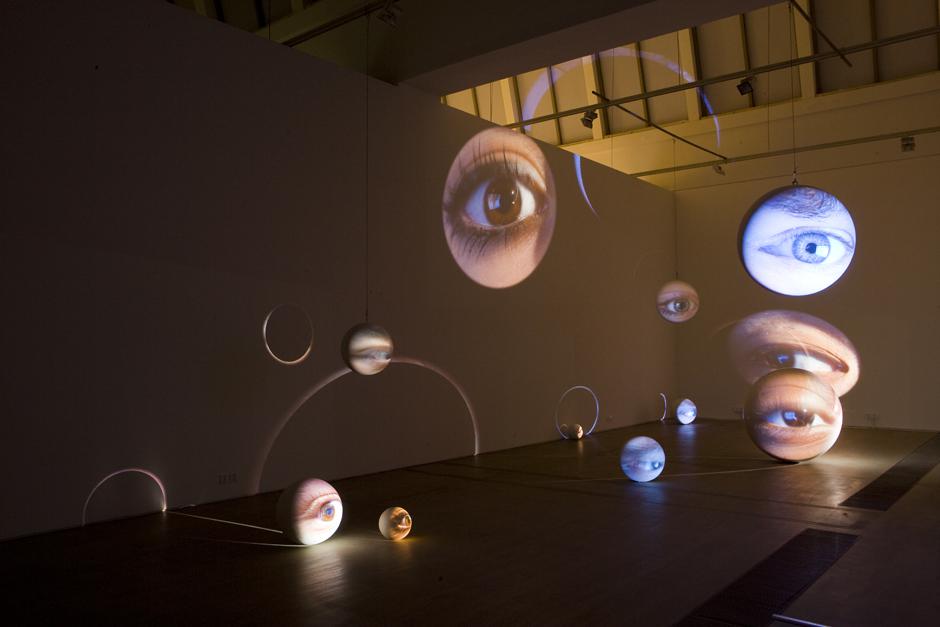
Image 001
Eyes
Eyes can be read in a number of ways as all art is open to the interpretation of the viewer based upon their own experience and perception39. He may be commenting upon how we view ourselves under the gaze of society, or upon Orwellian Big Brother culture40. Oursler may be commenting upon celebrity and the expectations many have for fame and adoration, highlighting the more uncomfortable aspects of it. No matter what the intent behind his work, Oursler’s Eyes is outstandingly Uncanny. When in motion the video of moving, blinking eyes grant the spheres and wall sections they are projected onto an Uncanny life. This motion drives the already Uncanny installation straight into the Uncanny Valley41.
An author may utilize devices such as the repetition of a specific audio-visual description42, or line of dialogue, throughout their narrative. Over time this builds an encroaching sense of dread, before a climactic switch of the idea in unleashes the full Uncanny terror43.
Similarly, cinematic narrative often makes use of repetition, for example repetition of non-diegetic44 audio-visual elements, such as splicing frames of the film into unexpected places, or use of non-diegetic sound-bytes. The sound-bytes, through their implementation as both motif and signifier, impact upon the audience’s emotional state. Take, for example, the theme in Jaws45. The audience knows that something bad is going to happen, the swimmer does not. As the music repeats, it gains intensity, pitch, and speed. This builds from a slow encroaching dread to all out terror when the shark strikes. It is particularly effective to a first time audience member, the first time it is used46.
Another example, wherein both non-diegetic sound and clever, sharp editing play a pivotal role in a cinematic narrative’s climactic success is that of Psycho47. Through the use of the shrill, repeating violin score, and short, sharp, edits of 78 film clips, a scene which was far more than the sum of its parts. Only in three frames does the knife actually appear to pierce the skin in the infamous shower sequence, although the effect upon the audience is that of a much more violent scene48.
Repetition and the double may be used as story or character devices alongside being cinematic tools. For example, The Shining49, which uses all of the aforementioned devices to disturb the audience, also utilizes Repetition and the Double in order to signify and portray the antagonist’s descent into madness. Patterned clothing, wallpaper and carpeting build from the outset a sense of preordained structure to the oncoming events of the narrative. These patterns help to develop the claustrophobic, labyrinthine nature of the Overlook Hotel within which the events play out, and the complexity of the antagonist’s downward spiral into madness. The climactic sequence ends within the maze garden in the hotel grounds, further signifying the man lost to his own maddening compulsion to murder his own family. A cinematic exploration of the Death Drive in action.
Taking these notions further, the narrative itself centres around a cyclic repetition of madness and murder in the hotel, with the antagonist seemingly doomed by forces outside his control to repeat past events. The antagonist is a writer, which is a significant role, as writing is an act of creation. Creative acts support the notion of free will, the thought that humanity is in control of its own thoughts and actions. The final signifier of his descent into madness is one of the most Uncanny moments in the film. His wife comes across massive piles of the work he has been doing at his typewriter. However, instead of his magnum opus, she finds the endlessly repeating words, “All work and no play makes Jack a dull boy.” Having forgone all pretence of free will, the antagonist has become a murderous automata.
The most primal Uncanny effect appears to come from the confusion between the animate, or inanimate nature of an object or entity. This effect factors into Jentsch’s discussion regarding the Uncanny as an evolutionary defence mechanism50. Jentsch elaborated upon this through an anecdote regarding a traveller whom sat upon a snake thinking it a tree root, recoiling in horror as it moved beneath51. Upon realization of what has happened, one is gripped by a fear of mortality. The fear comes from the danger of being killed by a known foe. However, the most profound fear occurred before this realization, in the period in which it appeared that the tree moved in a controlled manner. This Uncanny horror, brought upon by the uncertainty over the animate nature of the travellers chosen seat, ensures the mistake will not be made again.
This example is of an Uncanny uncertainty regarding the nature of external factors, and how it upsets the internal perception of reality held by the traveller. However, there is also the possibility that part of the Uncanniness came from a realization that the traveller had misunderstood his own internal perceptions, that reality was not as imagined52. This disruption between reality and imagination – that the root was not actually a root, and whatever image the movement had conjured about its true nature before revelation – creates an Uncanny conundrum53.
An event which both Jentsch54 and Freud55 agreed caused an immense Uncanny, or demonic, effect was the witnessing of an epileptic fit or a trance. Jentsch, using nurses as example, suggested that increased exposure and intellectual mastery can negate this Uncanny effect56. To those ignorant of its cause, a fit could easily be seen as symptomatic of a broken machine or, through religious eyes, an act of demonic possession. Witnessing another human as a mechanism out of control, a fleshy vehicle without an apparent pilot, we are faced with a dilemma. If this can happen to another person, might it happen to me? Faced with this notion of a loss of control, we are faced with the loss of the fundamental human notion of free will. That, beneath the illusion, humanity is simply a mechanical entity, devoid of freedom of thought, emotion, and choice, is a thought loaded with Uncanny uncertainty.
In a similar vein to the animate being mistaken as inanimate, the inanimate husk left after death can maintain an Uncanny power. Due to a preconception held that the corpse is animate as it once was in life57, the dead appear as sleeping, almost ready to wake and rise. Seeing the dead acts as a reminder that at some point we will all die, and become a mere echo of our former selves. Our lives, hopes, dreams, and loves all lost, leaving only the broken machine of flesh.
9 Jentsch, E. 1906 (in Jentsch, E. 1997)
10 Royle, N. 2003. Page 8.
11 Jentsch, E. 1906 (in Jentsch, E. 1997).
12 Freud, S. 1919 (in Freud, S. 2003).
13 Mori, M. 1970.
14 Tronstad, R. 2008 Page 1-9.
15 Royle, N. 2003.
16 Jentsch, E. 1906 (in Jentsch, E. 1997).
17 A dislike of novelty, which e took to mean displeasure of the difficulty the brain undertook in making sense of unfamiliar stimulus.
18 A thought which ties the Uncanny to the birth of religion.
19 This internalization means that repressed thoughts and feelings returned to light can have a profound and inescapable Uncanny impact. As the fears are tied to the sense of self, their origins may not even be identifiable. See Jentsch, E. 1906 (in Jentsch, E. 1997).
20 Jentsch, E. 1906 (in Jentsch, E. 1997).
21 Freud, S. (in Gay, P. ed. 1995).
22 Freud, S. 1919 (in Freud, S. 2003).
23 Freud, S. 1919 (in Freud, S. 2003).
24 Freud, S. 1919 (in Freud, S. 2003).
25 Royle, N. 2003. Page 7-8.
26 Eyre, S. ed. & Page, R. ed. 2008.
The tropes are:
• Inanimate objects mistaken as Animate
• Animate entities appearing Inanimate or Mechanical
• Blindness
• The Double
• Repetition
• Being Buried Alive
• A Hive Mind
• Confusion between Reality and Imagination
• The Death Drive
27 Royle, N. 2003. Page 2.
28 Royle, N. 2003. Page 92.
29 Royle, N. 2003. Page 92-93.
30 The Reality of Peace 1917 page 682, cited in Royle, N. 2003 page 100.
31 Freud, S. 1919 (in Freud, S. 2003 page 139-140).
32 Freud, S. 1919 (in Freud, S. 2003). 151
33 The Double is extremely common within cinematic narrative. Particularly strong examples can be found within the following films:
• The Shining
• Dead Ringers
• Being John Malkovich
• Inland Empire
34 Freud, S. 1919 (in Freud, S. 2003). Page 144.
35 Freud, S. 1919 (in Freud, S. 2003). Page 145.
36 Gallery notes from exhibition: Number 7, Plus or Minus 2 at Faurschou Gallery, Beijing February 6th – May 10th 2010.
37 Faurschou Gallery, 2010.
38 Freud, S. 1919 (in Freud, S. 2003). Page 146.
39 Lehman, P. and Luhr, W. 2003.
40 The police state of Orwell's novel 1984, wherein everyone was monitored and interrogated by the thought police. In contemporary Britain, Closed Circuit Television Cameras line the streets of many cities, monitoring the behaviour of the citizens. Also, Big Brother has been taken as the name of a voyeuristic reality television programme, wherein a captive group of contestants are monitored day and night by the public for several weeks.
41 See – The Uncanny Valley.
42 For example, the short story The Judge's House by Bram Stoker
43 A good example is Double Room by Ramsey Campbell, wherein a man in a hotel room finds that someone in the room beside him is mirroring all of his actions.
Double Room can be found in:
Eyre, S. ed. & Page, R. ed. 2008.
44 The use of elements outwith the fictional universe of the narrative, employed to communicate directly with the audience rather than the participants of the narrative.
45 Spielberg, S. 1975.
46 Although they know the film is about shark attacks, they will have little or no idea how the attack itself will play out, with their imaginations filling the Uncanny blanks.
47 Hitchcock, A. 1960.
48 North, S. 2010.
49 Kubrick, S. 1980.
50 Jentsch, E. 1906 (in Jentsch, E. 1997).
51 Jentsch, E. 1906 (in Jentsch, E. 1997).
52 Jentsch, E. 1906 (in Jentsch, E. 1997).
53 Disbelief that an event has been witnessed, or that another person could behave in another manner than one is accustomed to could become the source of an Uncanny upset, especially if there is no third party to verify the events. As time passes, or on trying to describe the events to others, the self doubt sets in. This leads to a questioning of ones own mental faculties, and in contemplating madness, one faces being out of control of oneself, an Uncanny state of being.
54 Jentsch, E. 1906 (in Jentsch, E. 1997). Page14.
55 Freud, S. 1919 (in Freud, S. 2003). Page 150.
56 Jentsch, E. 1906 (in Jentsch, E. 1997).
57 Jentsch, E. 1906 (in Jentsch, E. 1997). Page 15.
9 Jentsch, E. 1906 (in Jentsch, E. 1997)
10 Royle, N. 2003. Page 8.
11 Jentsch, E. 1906 (in Jentsch, E. 1997).
12 Freud, S. 1919 (in Freud, S. 2003).
13 Mori, M. 1970.
14 Tronstad, R. 2008 Page 1-9.
15 Royle, N. 2003.
16 Jentsch, E. 1906 (in Jentsch, E. 1997).
17 A dislike of novelty, which e took to mean displeasure of the difficulty the brain undertook in making sense of unfamiliar stimulus.
18 A thought which ties the Uncanny to the birth of religion.
19 This internalization means that repressed thoughts and feelings returned to light can have a profound and inescapable Uncanny impact. As the fears are tied to the sense of self, their origins may not even be identifiable. See Jentsch, E. 1906 (in Jentsch, E. 1997).
20 Jentsch, E. 1906 (in Jentsch, E. 1997).
21 Freud, S. (in Gay, P. ed. 1995).
22 Freud, S. 1919 (in Freud, S. 2003).
23 Freud, S. 1919 (in Freud, S. 2003).
24 Freud, S. 1919 (in Freud, S. 2003).
25 Royle, N. 2003. Page 7-8.
26 Eyre, S. ed. & Page, R. ed. 2008.
The tropes are:
• Inanimate objects mistaken as Animate
• Animate entities appearing Inanimate or Mechanical
• Blindness
• The Double
• Repetition
• Being Buried Alive
• A Hive Mind
• Confusion between Reality and Imagination
• The Death Drive
27 Royle, N. 2003. Page 2.
28 Royle, N. 2003. Page 92.
29 Royle, N. 2003. Page 92-93.
30 The Reality of Peace 1917 page 682, cited in Royle, N. 2003 page 100.
31 Freud, S. 1919 (in Freud, S. 2003 page 139-140).
32 Freud, S. 1919 (in Freud, S. 2003). 151
33 The Double is extremely common within cinematic narrative. Particularly strong examples can be found within the following films:
• The Shining
• Dead Ringers
• Being John Malkovich
• Inland Empire
34 Freud, S. 1919 (in Freud, S. 2003). Page 144.
35 Freud, S. 1919 (in Freud, S. 2003). Page 145.
36 Gallery notes from exhibition: Number 7, Plus or Minus 2 at Faurschou Gallery, Beijing February 6th – May 10th 2010.
37 Faurschou Gallery, 2010.
38 Freud, S. 1919 (in Freud, S. 2003). Page 146.
39 Lehman, P. and Luhr, W. 2003.
40 The police state of Orwell’s novel 1984, wherein everyone was monitored and interrogated by the thought police. In contemporary Britain, Closed Circuit Television Cameras line the streets of many cities, monitoring the behaviour of the citizens. Also, Big Brother has been taken as the name of a voyeuristic reality television programme, wherein a captive group of contestants are monitored day and night by the public for several weeks.
41 See – The Uncanny Valley.
42 For example, the short story The Judge’s House by Bram Stoker
43 A good example is Double Room by Ramsey Campbell, wherein a man in a hotel room finds that someone in the room beside him is mirroring all of his actions.
Double Room can be found in:
Eyre, S. ed. & Page, R. ed. 2008.
44 The use of elements outwith the fictional universe of the narrative, employed to communicate directly with the audience rather than the participants of the narrative.
45 Spielberg, S. 1975.
46 Although they know the film is about shark attacks, they will have little or no idea how the attack itself will play out, with their imaginations filling the Uncanny blanks.
47 Hitchcock, A. 1960.
48 North, S. 2010.
49 Kubrick, S. 1980.
50 Jentsch, E. 1906 (in Jentsch, E. 1997).
51 Jentsch, E. 1906 (in Jentsch, E. 1997).
52 Jentsch, E. 1906 (in Jentsch, E. 1997).
53 Disbelief that an event has been witnessed, or that another person could behave in another manner than one is accustomed to could become the source of an Uncanny upset, especially if there is no third party to verify the events. As time passes, or on trying to describe the events to others, the self doubt sets in. This leads to a questioning of ones own mental faculties, and in contemplating madness, one faces being out of control of oneself, an Uncanny state of being.
54 Jentsch, E. 1906 (in Jentsch, E. 1997). Page14.
55 Freud, S. 1919 (in Freud, S. 2003). Page 150.
56 Jentsch, E. 1906 (in Jentsch, E. 1997).
57 Jentsch, E. 1906 (in Jentsch, E. 1997). Page 15.
The Uncanny Valley
The lifeless flesh machine plays a part in the effect known as the Uncanny Valley. Coined by Masahiro Mori in 1970 in the study of robotics58, the Uncanny Valley effect impacts upon any humanoid creation. From dolls to visual effects, the Uncanny Valley can either make or break a creative work. The Uncanny Valley itself is a chart wherein the more lifelike a humanoid creation becomes, the more it engaging it becomes, to a point. After this point, it becomes rapidly and profoundly disturbing, as the creations become viewed as eerie zombies, Uncanny to the core59. It is thought that, if the realism is pushed even further, then the creation will climb back out of the Valley and become more engaging once again60. Scientists and film producers are interested in avoiding the Uncanny Valley, as it could cost them a fortune if crowds do not go to see their films61, or if the robots or interfaces they have designed do not engage the public.
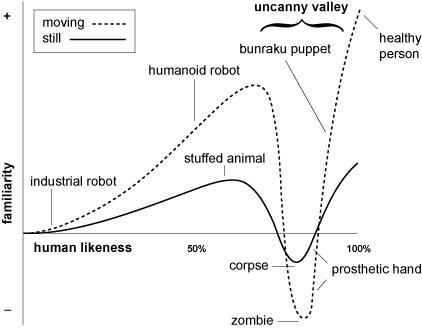
Image 002
Uncanny Valley Chart
The significance of the Uncanny Valley reaches far beyond the mitigating factors of the success of a Hollywood blockbuster. The effect highlights a key factor in the relationship of the Uncanny to human evolution. If an entity imitates something it is not, without being convincing enough to be regarded real, it enters the Uncanny Valley. An example of this in nature would be the Cuckoo. The Cuckoo is a parasitic bird which lays its eggs in the nests of other species. Upon hatching, the other bird treats the Cuckoo as its own, and the Cuckoo proceeds to starve out the host’s offspring by eating all of their food.

Image 003
Reed Warbler Feeding A Cuckoo
The human response to the Uncanny Valley may have evolutionary ties to avoidance of parasitic behaviours such as those of the Cuckoo. This ties in with Jentsch’s views of intellectual uncertainty, and Freud’s views of the inherent primitive animal behaviour of humanity. Relating the human Uncanny Valley response to the parasitic traits of creatures such as the Cuckoo are the folk tales of Changelings62 prevalent in Europe. A changeling was thought to have taken the place of a baby if, for instance, it had been born deformed, or suffering from Down Syndrome. Greater, more widespread, medical knowledge stymied this belief, supporting Jentsch’s theory that intellectual mastery negates Uncanniness. However, as late as 1895, in Ireland, a woman was burned to death by her husband whom believed her to be a Changeling63. The notion that the Uncanny Valley response is evolutionary is supported by the findings that primates are also affected by the Uncanny Valley64. Aside from the avoidance of parasitic behaviour, Steckenfinger and Ghanzafar discussed the possibility that it aided in avoidance of diseased humans, another evolutionary defence mechanism65.
However, the Uncanny Valley is a ripe ground for artists seeking to create a profound impact upon their audience. For example, Winkler + Noah created the Puppet Show, 200966, a series of manipulated portrait photographs of children made to represent dolls. This work transcends the Uncanniness of automata into the Uncanny Valley through subtle photographic manipulation.

Image 004
Liera
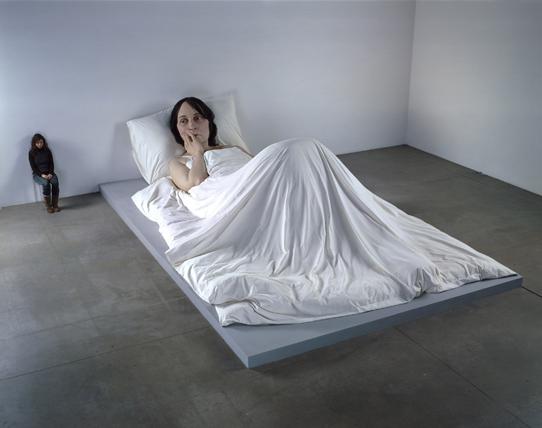
Image 005
In Bed

Image 006
Queenie 2
58 Mori, M. 1970.
59 A strong example would be the characters in the all computer graphic 3d film The Polar Express. The characters, especially the children, looked on first glance realistic however lacked any real sense of human emotion and movement. This occurred even though the actors were motion captured in order to maintain a sense of realism. Animator Ward Jenkins dissected some of the scenes and elaborated upon what went wrong in his blog:
http://wardomatic.blogspot.com/2004/12/polar-express-virtual-train-wreck_18.html
60 Mori, M. 1970.
61 For example, the film Final Fantasy; Spirits Within has the following box office information (according to Boxofficemojo.com):
Production Budget: $137,000,000
Global Takings: $85,131,830
Overall Loss: $51,868,170
The film itself was among the first to fall foul of the Uncanny Valley on such a large scale, as it was the first ever photo-realistic computer animated film.
62 Mack, C. K. and Mack, D. 2008. Page 202-203.
63 Youmans, W. J. ed. 1896. Page 87.
64 Steckenfinger, S. A., Ghazanfar, A. A. 2009.
65 Steckenfinger, S. A., Ghazanfar, A. A. 2009.
66 A reflection upon the loss of innocence and naturality of children through social and media interference and manipulation. The collection can be seen at:
http://puppet-show.net/project.html
58 Mori, M. 1970.
59 A strong example would be the characters in the all computer graphic 3d film The Polar Express. The characters, especially the children, looked on first glance realistic however lacked any real sense of human emotion and movement. This occurred even though the actors were motion captured in order to maintain a sense of realism. Animator Ward Jenkins dissected some of the scenes and elaborated upon what went wrong in his blog:
http://wardomatic.blogspot.com/2004/12/polar-express-virtual-train-wreck_18.html
60 Mori, M. 1970.
61 For example, the film Final Fantasy; Spirits Within has the following box office information (according to Boxofficemojo.com):
Production Budget: $137,000,000
Global Takings: $85,131,830
Overall Loss: $51,868,170
The film itself was among the first to fall foul of the Uncanny Valley on such a large scale, as it was the first ever photo-realistic computer animated film.
62 Mack, C. K. and Mack, D. 2008. Page 202-203.
63 Youmans, W. J. ed. 1896. Page 87.
64 Steckenfinger, S. A., Ghazanfar, A. A. 2009.
65 Steckenfinger, S. A., Ghazanfar, A. A. 2009.
66 A reflection upon the loss of innocence and naturality of children through social and media interference and manipulation. The collection can be seen at:
http://puppet-show.net/project.html
Uncanny Preservations of Death;
Cinema holds the key to life after death. In a sense. With the birth of cinema corresponding to the pivotal works of Freud and Jentsch, and strong ties between the psychoanalysis of dreams, and cinema as a public forum for the projection of waking dreams, they are Uncanny bedfellows67. However, this discussion does not revolve around the psychoanalysis of these public dreams, but on the nature of the medium itself.
Scholar Laura Mulvey, in Death 24x a Second; Stillness and the Moving Image68, puts forth the argument that instead of merely telling a story, cinema Uncannily reanimates the dead. Discussing the traditional photographic index69, Mulvey argues that the reaction binds forever the essence of the subject captured, their movement and vitality. Presenting a photograph to a spectator is more fundamentally confusing or disturbing than the discovery of ancient artefacts. This is because the subject in a photograph is captured in the present. It does not age, and, for the subject of the image, time does not pass. Even if the paper begins to wear over time, its contents do not. However, the camera has not captured life, but the spectre of it, trapped forever in the instant of photography. Portraits of the dead70.
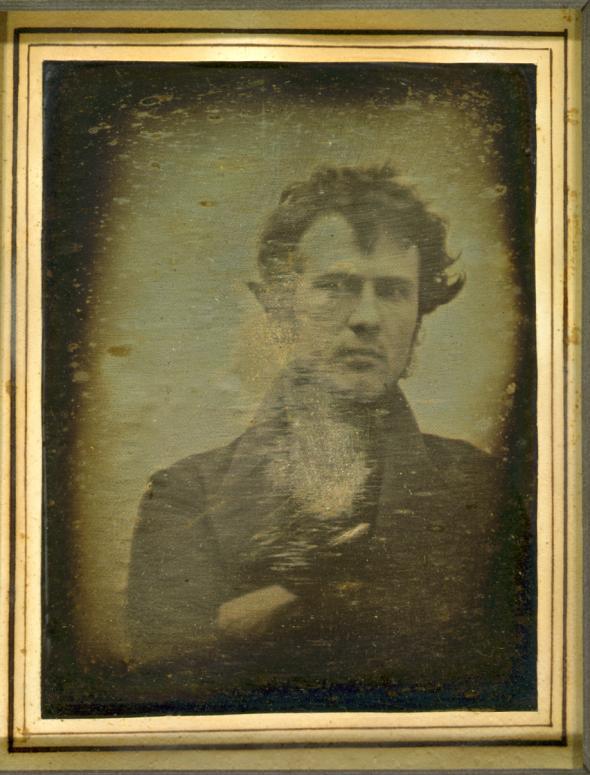
Image 007
Self Portrait of Robert Cornelious
Inversely, film reanimates the dead through optical illusion, similar to the trickery of the early Zoetropes71. By presenting the viewer with 24 successive frames of photography every second the mind is tricked into believing that the image is moving. In keeping with Mulvey’s argument about the photographic index, this would imply that cinema was indeed reanimating the dead. Preserving forever those captured on film. Take, for instance, the early silent film star Charlie Chaplin. Watching any of his films now, the audience can witness him in the prime of his life, always in the present. Chaplin has been dead since the 25th of December 1977. For as long as his films are still in existence, in a medium which can be played, those born after his demise can still watch him live.
The Uncanniness of Death’s rebirth through film has taken one step further due to contemporary playback technology. Death can be played forwards, backwards, in slow motion, or even, as Mulvey points out, reduced back to its original silent spectre of motionless movement and deathly life72. Mulvey’s arguments can be contested, however they do provide grounds for thought.
The same technology which allows for the manipulation of the illusion of life has also removed the original physical index. Digital photography no longer captures imagery through the chemical reactions of the film and light. Instead, it renders the image digitally in a format unreadable by the human eye, accessible and understandable only to a machine. Lives captured through digital photography become ghosts in the machine, sustained only by electricity and technology.
This notion gives rise to questions relating to the Uncanny Valley. If photo-realistic imagery is created and animated through the use of the machine, is it possible that our Uncanny revulsion stems not just from suspect realism? When a series of photo-realistic virtual images are brought to life through illusory animation we are faced with spectres which never truly existed outwith our minds. Are we faced with the Uncanny Doppelgänger of our own cinematic ghosts?
A similar Uncanniness can be found in the preservation of the dead. From ancient times onwards, mankind has sought to preserve the dead. Of the ancient Egyptians, Freud noted that it was common practice to create effigies using lasting materials, helping the deceased to live forever (echoed in contemporary culture with photographic documentation). Instead of their desire, the effigies instead became, to Freud, an “Uncanny harbinger of Death73.” The practice of mummification was another method of preserving the dead for eternity.
Death Masks, or Life Masks as they are also known, are effigies to the dead created from casts of their faces taken upon death. They are also sometimes taken from those still alive, for the sake of vanity. Through the use of wax or plaster, the image of the dead is preserved forever, maintaining the Uncanny illusion that it, like the body it was cast from, may awake and live again. Both Death and Life Masks are used in the preparation of figurative sculptures in order to maintain realism. This element adds to the Uncanny nature of many works74.
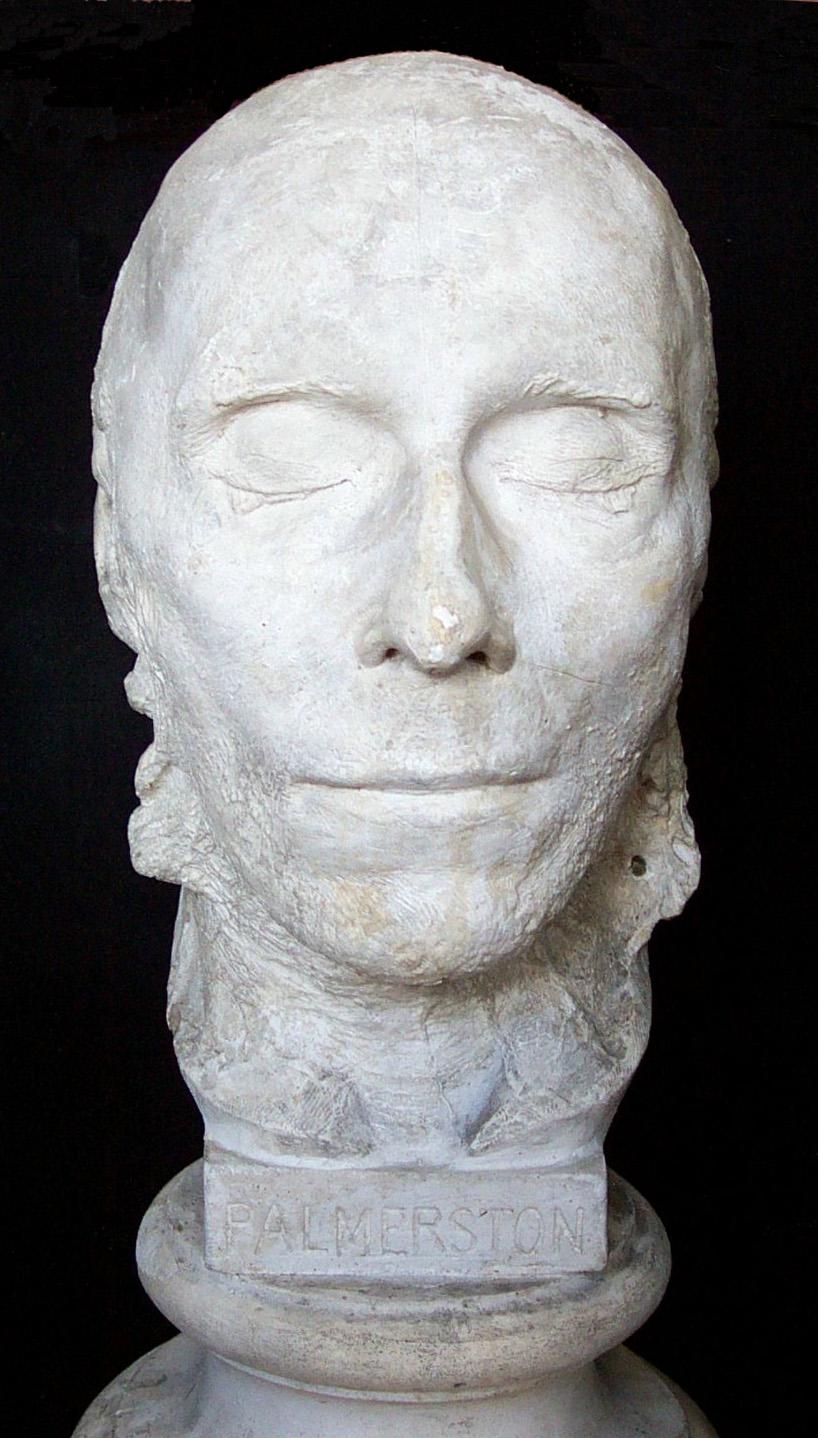
Image 008
Original Death Mask of Henry John Temple, 1784 - 1865
Image: 008
Title: Original Death Mask of Henry John Temple, 1784 - 1865
Created By: Unknown
Date: 1865
Source: Laurence Hutton Collection of Life and Death Masks; A Pictorial Guide.
Manuscripts Division, Department of Rare Books and Special Collections.
Princeton University Library.
http://library.princeton.edu/libraries/firestone/rbsc/aids/C0770/p-s.html#p-s
67 Lebeau, V. 2001.
68 Mulvey, L. 2006.
69 A physical, chemical trace which is left on photographic film through reaction to light, outwith any human contact.
70 Image 007 is thought to be the first portrait photograph ever taken. On the back of this self portrait, Robert Cornelious wrote. “The First light picture ever taken, 1839.” He was one of the pioneers of photography in America, and whilst the picture is fading, the vitality it captured has not.
71 See the Victoria and Albert Museum of Childhood for details: http://www.vam.ac.uk/moc/collections/toys/moving_toys/optical_toys/zoetrope/index.html
72 Mulvey, L. 2006.
73 Freud, S. 1919 (in Freud, S. 2003.) Page142.
74 For example, the eerie waxworks in Madame Tussauds.
67 Lebeau, V. 2001.
68 Mulvey, L. 2006.
69 A physical, chemical trace which is left on photographic film through reaction to light, outwith any human contact.
70 Image 007 is thought to be the first portrait photograph ever taken. On the back of this self portrait, Robert Cornelious wrote. “The First light picture ever taken, 1839.” He was one of the pioneers of photography in America, and whilst the picture is fading, the vitality it captured has not.
71 See the Victoria and Albert Museum of Childhood for details: http://www.vam.ac.uk/moc/collections/toys/moving_toys/optical_toys/zoetrope/index.html
72 Mulvey, L. 2006.
73 Freud, S. 1919 (in Freud, S. 2003.) Page142.
74 For example, the eerie waxworks in Madame Tussauds.
Sculpture in the Virtual Age
Hepworth, 193775, believed sculpture to be a spatial expression. She felt that, in order for a sculpture to be emotionally and intellectually engaging, the artist must seamlessly integrate their ideas with knowledge of their materials’ properties.
What could it mean, therefore, if the laws of the physical world were removed in the creation of expressive sculptures? With no law of gravity, and no limit to material, sculpture can now be created digitally, and integrated into an environment in a photo-realistic manner. In a way, this is similar to the relationship the Uncanny Valley of 3d computer animated humans shares with the traditional photographic index. What appears be tactile reality, captured as a material trace through the chemical reaction of light on film, is in fact a non-entity, never having existed in physical form. It is the creation of imagination, rendered as flesh and clay caught on camera. However, methods now available allow the digital sculptor to breach the fourth wall76 granting physical reality to digital works. Rapid prototyping machines, and robots at the forefront of current scientific technology, can be utilized in the creation of real world sculptures based upon their digital counterparts77.
In this there are ties to Hepworth’s views as, if the sculptor is intending for the digital work to enter the physical realm, consideration must be paid by the artist to the end materials, and their physical properties78. The difference here is that these considerations may come last, as the digital sculpture is prepared for physical execution. In this way, physical properties do not hinder creative progress. Consideration must also be paid if the artist is creating a photo-realistic image of a digital sculpture too, as in order to create the illusion of reality, attention must be paid to the rules of reality. Doing so, an artist can create a convincing illusion.
Hepworth believed that the life and vitality of a sculpture come not from the material properties or physicality of the sculpture itself, but from the imagination of the sculptor brought to life. If the vitality comes not from the physical nature of the sculpture, but instead from what Hepworth called its “inner spiritual life79” then it matters not whether the sculpture is made of clay, stone, bronze, or pixels. A digital sculpture rendered photo-realistically is the Uncanny relative of the physical sculpture captured on photographic film. To the viewer, it is the same experience, as the interpretation of a real object and an imagined one, such as a dream or illusion, is conducted using the same neural machinery. The “real and imagined share a physical source in the brain80.” If executed properly, a digital sculpture could be taken as a physical one.
Creating a specifically staged revelation of the work could influence this further. If there is no mention of the process involved, or if the documentation describes the process of creation as if it had been made of real materials, the audience (especially the distance audience with no access to the original gallery space where the work was hosted) could more easily embrace the work as physical. Note the importance of the framing of the work; most viewers will never see the original artwork. Instead, they will view reproductions, on paper, canvas, and screen. In this realm, only the appearance of authentic reality is of importance. An artwork which appears completely real will be taken as such until intervention negates the illusion.
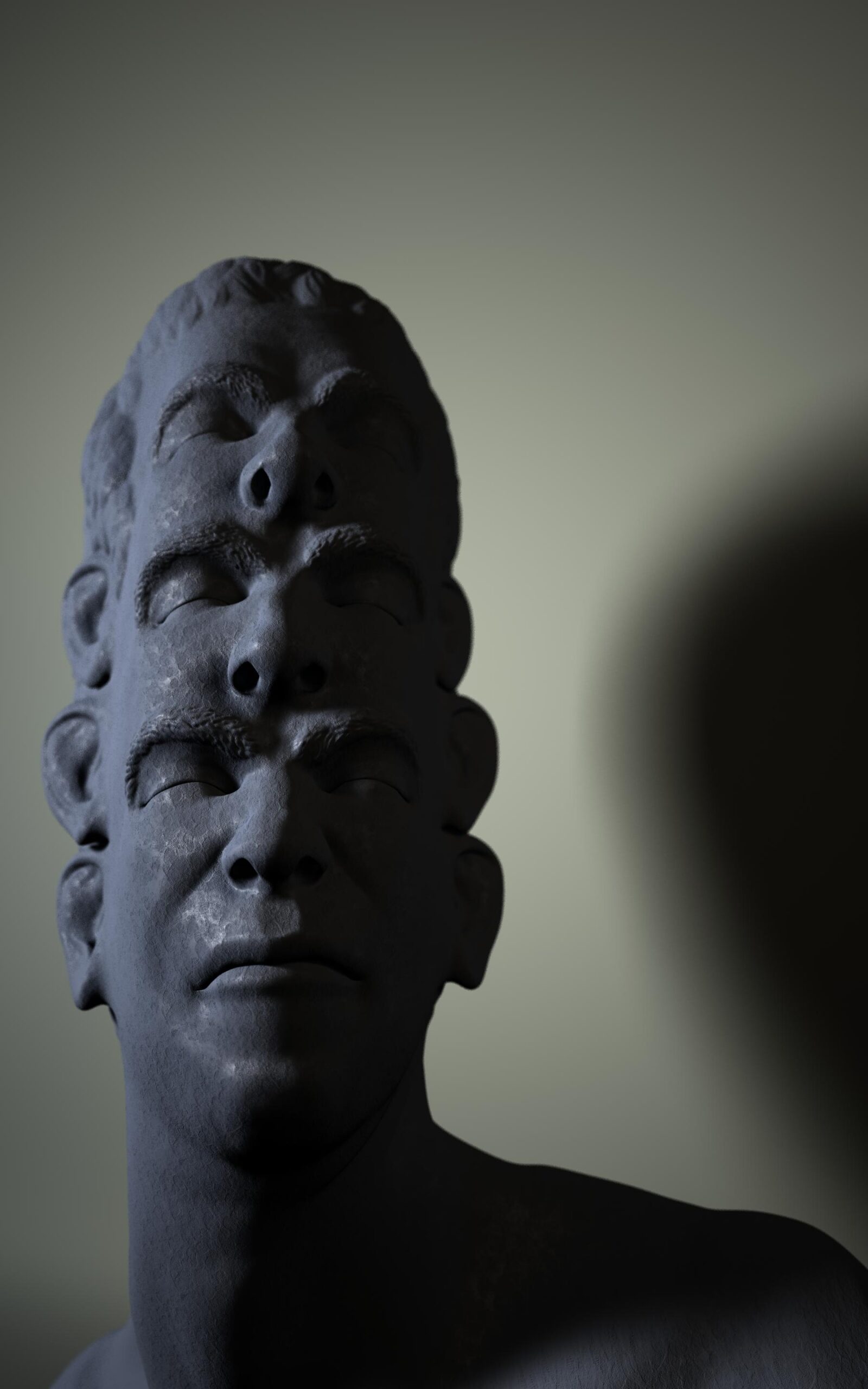
Image 009
Sleepyhead 001
Hepworth said that the physicality of a sculpture, its scale and contours, had no bearing upon its spiritual significance, which came from the symbiosis of conception and realisation. If the sculptor’s thoughts came together, and were executed correctly, a work could have profound impact and meaning, regardless of scale81.
To Hepworth, the creation of sculpture was the convergence of the conscious and unconscious minds. The vitality coming from the unconscious self of the creator, the critical decision making in its moulding from the creator’s conscious edit82. The most impacting artwork expresses the creator’s reflection of the world around them, filtered through their life experience and sense of self. As Hepworth stated, the works of an artist from a pre-modern culture, where mythology reigned over the populous, would reflect this by featuring recognisable gods, though this would be an unconscious influence. In the same way, artists and film makers are influenced unconsciously by their life and cultural experience, a trait particularly strongly recognisable in the horror genre of narrative arts83. Echoing Hepworth, Lassaw84 believed that art and art movements were an entwined aspect of the culture of any era. With the advent of photography and the cinema, non-photographic art as a whole changed, to explore more than it had previously been put to use to achieve.
Where art had once been used as an almost purely representational, or story telling device, it had now been usurped. To Lassaw, art could not possibly achieve these things to the same standard as the, stationary or moving, photographic image85. Instead, art became the grounds for emotional and psychological expression. He believed that it was impossible to create strong artworks where the influence was the style, technique, or cultural and psychological beliefs of the past. Lassaw argued that artists had to move from representing reality, to making it. This was valid at the time, however, it is even more valid now, given the ability to create virtual worlds within which people can interact86, or experience an engaging narrative87. It could be argued that as these pieces are vast group efforts, there is a loss of individual artistic identity. This is not the case88. The new technology affords the same opportunity to the group works as it does to the individual artist. Examples of artists whom have embraced the technological advancements are Andrew Jones89 and Meats Meier90.
Though Hepworth died before the advent of the technology which made current technologically advanced artistic practice possible, her views on sculpture were highly influential. Had she been alive to witness the current technological and artistic possibilities, who knows what she would have thought? The one thing that is certain, her ideas still stand strong, and are as accessible, and applicable, now as they were in her era. The power and vitality of a sculpted work comes not from within the clay, stone, or pixels making the piece, but from the expressive and intellectual intent of the artist. In this way, a virtual sculpture rendered as photograph may have the same vitality, power, and expressive impact as a clay sculpture captured in a photograph.
75 Hepworth, B. 1937 (in Harrison, C. ed. & Wood, P. ed. 2003.) Page 393 – 396.
76 A term from cinema and theatre where the characters in a narrative break free from the binds of their fictional world to address the audience. The term can be taken to mean anything which causes this kind of effect.
77 For example: http://maximus.emecstudios.com/
78 This is so that printed materials will be thick enough to support the sculpture against the effects of gravity.
79 Hepworth, B. 1937 (in Harrison, C. ed & Wood, P. ed 2003.)
80 Martinez-Conde, S. and Macknik, S. L. 2010. Page 4.
81 Hepworth, B. 1937 (in Harrison, C. ed & Wood, P. ed 2003.)
82 Hepworth, B. 1937 (in Harrison, C. ed & Wood, P. ed 2003.)
83 Lawton, C. 2006.
84 Lassaw, I. 1938 (in Harrison, C. ed & Wood, P. ed 2003.) Page 397 – 398.
85 Lassaw, I. 1938 (in Harrison, C. ed & Wood, P. ed 2003.) Page 397 – 398.
86 For instance: World of Warcraft, or Heavy Rain
87 For example, the film Avatar.
Cameron, C. 2009
88 Although many of those involved are putting their talents towards the execution of a given brief (which could be taken as design led practice), all are progressing towards the collective goal. In a sense, working as a super organism operating under the control of a hive mind.
89 http://androidjones.net/art/?album=1&gallery=4
90 http://www.3dartspace.com/index.php?option=com_content&task=view&id=244&Itemid=27
75 Hepworth, B. 1937 (in Harrison, C. ed. & Wood, P. ed. 2003.) Page 393 – 396.
76 A term from cinema and theatre where the characters in a narrative break free from the binds of their fictional world to address the audience. The term can be taken to mean anything which causes this kind of effect.
77 For example: http://maximus.emecstudios.com/
78 This is so that printed materials will be thick enough to support the sculpture against the effects of gravity.
79 Hepworth, B. 1937 (in Harrison, C. ed & Wood, P. ed 2003.)
80 Martinez-Conde, S. and Macknik, S. L. 2010. Page 4.
81 Hepworth, B. 1937 (in Harrison, C. ed & Wood, P. ed 2003.)
82 Hepworth, B. 1937 (in Harrison, C. ed & Wood, P. ed 2003.)
83 Lawton, C. 2006.
84 Lassaw, I. 1938 (in Harrison, C. ed & Wood, P. ed 2003.) Page 397 – 398.
85 Lassaw, I. 1938 (in Harrison, C. ed & Wood, P. ed 2003.) Page 397 – 398.
86 For instance: World of Warcraft, or Heavy Rain
87 For example, the film Avatar.
Cameron, C. 2009
88 Although many of those involved are putting their talents towards the execution of a given brief (which could be taken as design led practice), all are progressing towards the collective goal. In a sense, working as a super organism operating under the control of a hive mind.
89 http://androidjones.net/art/?album=1&gallery=4
90 http://www.3dartspace.com/index.php?option=com_content&task=view&id=244&Itemid=27
Surrealism, Creativity, & the Self
Inspired by Freud, André Breton set about writing the First Manifesto of Surrealism in 1924. This, though preceding Lassaw’s essay, fulfilled his thoughts on creating new art perfectly. In the age of psychoanalysis and the subconscious, dreams and the Id, Surrealism was the perfect evolution of Art. Breton wished to explore the resolution of the states of dream and reality into “a kind of absolute reality, a surreality, if one may so speak91.” He rejected outright the methods and thinking of old, claiming that absolute rationalism relates only to our direct experience. New thoughts, therefore, could not come from rationalism alone. He found Freudian theory as grounds ripe for exploration. This new movement, Surrealism, changed the future of Art greatly. Now, throughout cultural expression, the influence of the Surrealists can be felt92. Breton defined Surrealism as:
“Psychic automatism in its purest state, by which one proposes to express – verbally, by means of written word, or in any other manner – the actual functioning of thought. Dictated by thought, in the absence of any other control exercised by reason, exempt from any aesthetic or moral concern93.”
This movement sought to explore not the world around us, but that inside. Not the feats of human being, but the very being of human. Ironically, their exploration of the functioning of thought through automatism in creation exposed the mechanisms which made them human without touching upon the freedom of thought.
The Surrealists strove not to lose touch with their imagination, and their capacity to connect with existence outside of culturally defined reality. Louis Aragon explored the prison of rational thought, and its effect upon imagination, in Paris Peasant94. He reflects poignantly that, as people grow older they lose their sense of imagination on a path to a quiet, real, life unburdened with the “taste and texture of the unwonted, the unthought of95.” This, he despairs, is something he will never experience. Aragon’s view also echoes that of Freud when he discussed the repression and avoidance of the “unpleasureable96.”
Elaboration suggests one can either take on the rational, culturally accepted experience of life, through complete submission to the beliefs and expectations of culture, or one can walk the other path alone. The other path is most often tread by artists and creative people, whom view the world differently than the general populous. Given current research into the functions of the brain at the Karolinska Institutet, this may be a choice made for the individual at birth, rather than a conscious choice made in life to conform to the cultural identity97. According to Manzano et al, 2010, there are links between the brain functions of highly creative people (such as artists) to those of people with psychiatric disorders. They concluded on the note that:
“It can be speculated that aberrant thalamic function may promote unusual associations, as well as improved performance on divergent thinking tests in healthy individuals, in the absence of the detrimental effects typically associated with psychiatric disorders. In other words, thinking outside the box might be facilitated by having a somewhat less intact box98.”
Aragon’s despair in 1924 may be well founded. The very rational thinking which Aragon and the Surrealists railed against, is now one step closer to proving the origin of creativity. This in turn could help lead, eventually, to the discovery and rationalisation of the very makings of our individuality and humanity. Future history may well reveal that mankind is yet another uncanny automata, a fleshy robot driven by a higher capacity for thinking and knowledge. Science, given the findings of research such as that of Manzano et al. may one day answer the question that Religion, Art, and Philosophy have been asking since the dawn of mankind; why are we here, and what is the meaning of life? Do we really want the answer?
A leading Surrealist, later extradited from the group, was Salvador Dali. His works represent the pinnacle of classic Surrealism; vast dreamscapes populated by the phantoms of his mind, and assembled objects and images which defy all rational thought. In his 1930 essay The Stinking Ass99, Dali described one of the key methods he employed in his works, labelled the paranoiac double image100. Imagery which, viewed from a differing angle, distance or perspective, will create another image. Dali’s goal was to discredit reality through the creation of such double images.
This technique, and its results, are Uncanny to the core. A distinct difference occurs in this work from the goals of the Surrealist Manifesto. There can be no way in which these images were created automatically. The inspiration could easily have come through automatic writing or drawing practices. However, their execution is of such extraordinary technical excellence that the paintings would have required meticulous planning. Such a method in this creation of art fits with Hepworth’s views of the synergy of the conscious and unconscious minds.
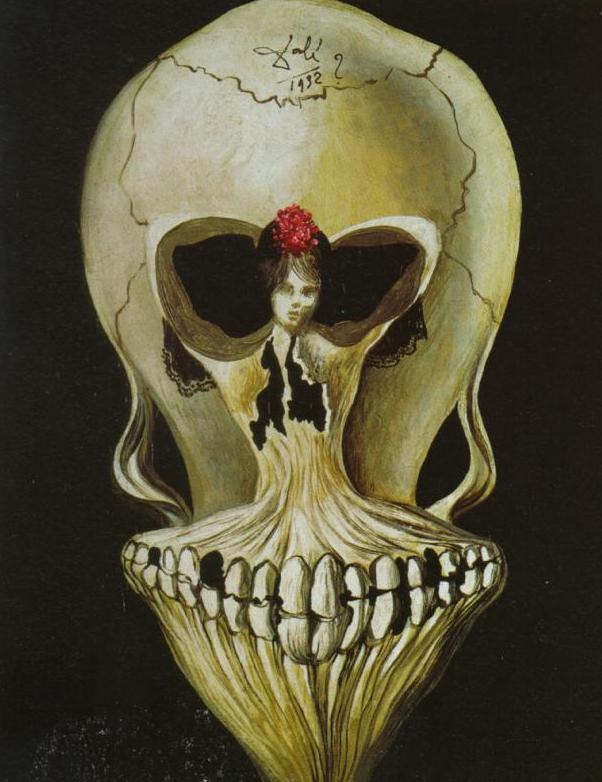
Image 010
Ballerina in a Death's Head
Dali’s double images share a kinship with the works of psychologist Herman Rorschach, whom in 1921 created the so-called Rorschach Ink Blot Test101. This test used a phenomenon of human perception, known as Pareidolia, wherein the mind filters an abstract shape or form into a recognisable image. A phenomena with its roots in Jentsch’s Uncanny uncertainty102; the mind sets out to make sense of an unfamiliar shape by finding familiar shapes and patterns within it. Inspiration, Rorshcach claimed, came from witnessing shapes in clouds, and the parlour games popularised by Justinus Koerner103.
Through such works as Mysterious Mouth Appearing in the Back of My Nurse, 1941, and The Image Disappears, 1938104, Dali used the double image technique to create fantastic dream imagery, wherein reality of perception is in permanent flux. Dali used this technique to explore dreams, perception, and reality. Later, Surrealist H. R. Giger would use similar perceptual tricks within his works. Exploring the primal drives of mankind, Giger’s work contains images that are at once landscapes, portraits, technological constructs, and graphic sexuality. Particularly potent are the viciously charged The Birth Machine, 1967, wherein the babies are bullets and the machine a gun signifying that we are born to die and born to kill, and the infamous Landscape XX, 1973. Landscape XX, more commonly known as Penis Landscape105, lead to an obscenity trial when the political punk band the Dead Kennedys attempted to use it as an album cover106.
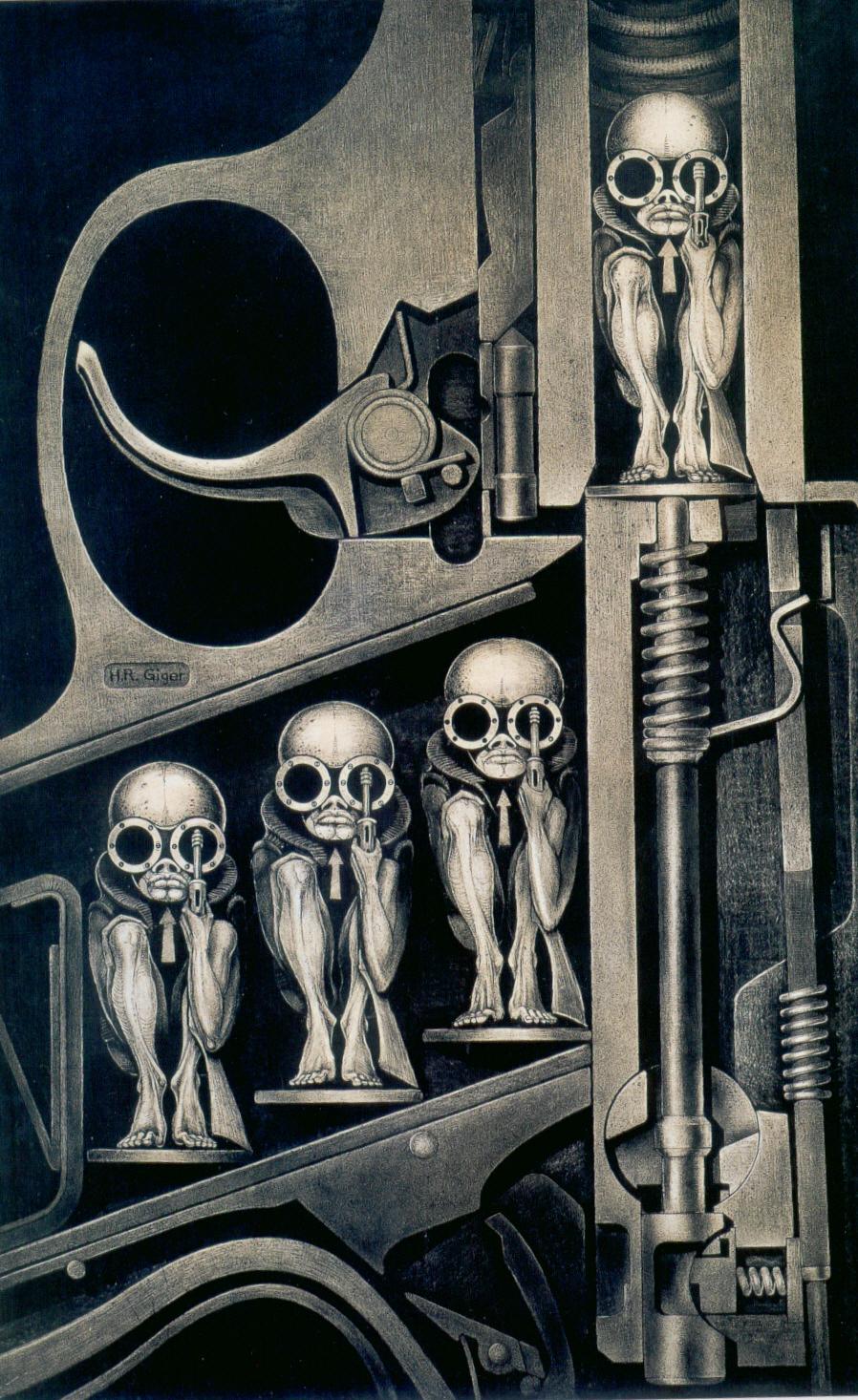
Image 011
The Birth Machine
Giger’s work relates less to Dali, than to Dali’s rival, author Georges Bataille. Bataille, whom referred to himself as Surrealism’s internal enemy, believed himself to be the most Surreal Surrealist107. This claim directly opposed Dali, whom once declared he was Surrealism108. The two had driven the evolution of Breton’s Surrealism oppositely. Dali explored the dream-life, the metaphysical, the spiritual. Bataille explored the material, corruption, flesh.
The works of the other Surrealists were, to Bataille, too tame, too timid. They shied away from the violent, hideous, uncivilised underbelly of civilised society109. Tythacott, citing Stoekl, 1985, described Bataille’s disgust at what he saw as the bestial nature of mankind. Particular contempt he held of the foot, which distinguish humanity from the animal whilst also being the one part still rooted in the earth110. He discussed torture, such as foot binding and the wearing of high heels, which he saw as attempts to civilize the animal.
To Bataille, the animal, base, instincts and drives, the horrible and debauched were intrinsic aspects of humanity. They were unavoidable, the civilized an intrinsic aspect of the savage. Bataille strove to see beyond the ideal, using example such as the ugliness of the roots of the beautiful flower hidden beneath the soil111. He was searching, in a sense, for the Uncanny truth of humanity.
Surrealism grew out of the desire to return to the repressed, to reclaim the existence which had become buried in the Enlightenment:
“Under the pretense of civilization and progress, we have managed to banish from the mind everything that may rightly or wrongly be termed superstition, or fancy; forbidden is any kind of search for truth which is not in conformance with accepted practices. … a part of our mental world which we pretended not to be concerned with any longer … has been brought back to light112.”
Through exploration of themselves, functioning both as automata and hyper critical thinkers, the Surrealists independently explored the repressed. The works of Freud heavily inspired the thinking of the Surrealists, and their goals. Consciously or unconsciously, the Surrealists were among the pioneers of the Uncanny in art. Visual inspiration for a lot of the Surrealists’ works may stem from earlier Uncanny artwork, such as the religious paintings of the Middle Ages.
91 Breton, A. 1924 (in Harrison, C. ed & Wood, P. ed 2003.) Page 450.
92 Bayley, S. 2007. The Observer (Online).
93 Breton, A. 1924 (in Harrison, C. ed & Wood, P. ed 2003.) Page 452.
94 Aragon, L. 1924 (in Harrison, C. ed & Wood, P. ed 2003.) Page 453-456.
95 Aragon, L. 1924 (in Harrison, C. ed & Wood, P. ed 2003.) Page 455.
96 Freud, S. (in Gay, P. ed. 1995).
97 http://ki.se/ki/jsp/polopoly.jsp?d=130&a=100727&l=en&newsdep=130
98 Manzano, Ö. d., Cevenka, S., Karabanov, A., Farde, L. Ullén, F. 2010.
99 Dali, S. 1930 (in Harrison, C. ed & Wood, P. ed 2003.) Page 486-489.
100 Dali, S. 1930 (in Harrison, C. ed & Wood, P. ed 2003.) Page 486-489.
101 Warner, M. 2006. Page 310.
102 Jentsch, E. 1906 (in Jentsch, E. 1997).
103 Warner, M. 2006. Page 309.
104 http://www.dali-gallery.com/html/galleries/paintings.htm
105 The image itself shows what appears to be an abstract landscape, constructed of sexual organs mid fornication, one of which is sheathed with a condom
106 Thrill, S. 2010.
107 Tythacott, L. 20003. Page 215-229.
108 http://www.abcgallery.com/D/dali/dalibio.html
109 Tythacott, L. 20003.
110 Stoekl, A. 1985 (cited in Tythacott, L. 20003.) Page 216.
111 Stoekl, A. 1985 (cited in Tythacott, L. 20003.) Page 218.
112 Breton, A. 1924 (in Harrison, C. ed & Wood, P. ed 2003.) Page 448.
91 Breton, A. 1924 (in Harrison, C. ed & Wood, P. ed 2003.) Page 450.
92 Bayley, S. 2007. The Observer (Online).
93 Breton, A. 1924 (in Harrison, C. ed & Wood, P. ed 2003.) Page 452.
94 Aragon, L. 1924 (in Harrison, C. ed & Wood, P. ed 2003.) Page 453-456.
95 Aragon, L. 1924 (in Harrison, C. ed & Wood, P. ed 2003.) Page 455.
96 Freud, S. (in Gay, P. ed. 1995).
97 http://ki.se/ki/jsp/polopoly.jsp?d=130&a=100727&l=en&newsdep=130
98 Manzano, Ö. d., Cevenka, S., Karabanov, A., Farde, L. Ullén, F. 2010.
99 Dali, S. 1930 (in Harrison, C. ed & Wood, P. ed 2003.) Page 486-489.
100 Dali, S. 1930 (in Harrison, C. ed & Wood, P. ed 2003.) Page 486-489.
101 Warner, M. 2006. Page 310.
102 Jentsch, E. 1906 (in Jentsch, E. 1997).
103 Warner, M. 2006. Page 309.
104 http://www.dali-gallery.com/html/galleries/paintings.htm
105 The image itself shows what appears to be an abstract landscape, constructed of sexual organs mid fornication, one of which is sheathed with a condom
106 Thrill, S. 2010.
107 Tythacott, L. 20003. Page 215-229.
108 http://www.abcgallery.com/D/dali/dalibio.html
109 Tythacott, L. 20003.
110 Stoekl, A. 1985 (cited in Tythacott, L. 20003.) Page 216.
111 Stoekl, A. 1985 (cited in Tythacott, L. 20003.) Page 218.
112 Breton, A. 1924 (in Harrison, C. ed & Wood, P. ed 2003.) Page 448.
Demonic Repression;
Medieval European artists created imagery steeped in the Uncanny. Through the creation of representational religious imagery, they delved into the depths of the human psyche. The Devil, ubiquitous symbol in Christian faiths for the evil inherit in man, and his minions in corruption, were represented in canvas and sculpture. Serving as propaganda, decorating churches and cathedrals in reminder to the masses that Hell awaits those who Sin113. This form of propagandised expression died out with the Enlightenment and the age of Reason. However, this formative age of Western Culture spawned some of the most Uncanny art the world has seen.
Take, from Christianity, the idea of Sin. Firstly, Original Sin, which many Christians believe to be an inherit flaw in Humanity, a tendency towards Sinning and Evil thoughts114. This battle to remain pure and Holy is said to be ongoing in all mankind from birth. Next, the Seven Deadly Sins; Wrath, Greed, Sloth, Pride, Lust, Envy, and Gluttony. These Sins are primal instinctual behaviours, fundamental aspects of humanity. However, they were used as a method of control during periods of high Theocratic influence115. A culture terrified of burning in Hell for eternity will behave more in accordance with its rules. Artistic depictions, in an era before mass communication and information availability, helped to spread the word.
Artists creating these images had free reign to create their grisly depictions. However, certain influences shone throughout. Pagan culture was distorted, and its Gods became their Uncanny Doppelgängers, the Demons of Christianity116 (in fitting with Freud’s theory117.) In this manner, Deities symbolising a celebration of life and the vital became tools of its oppression.
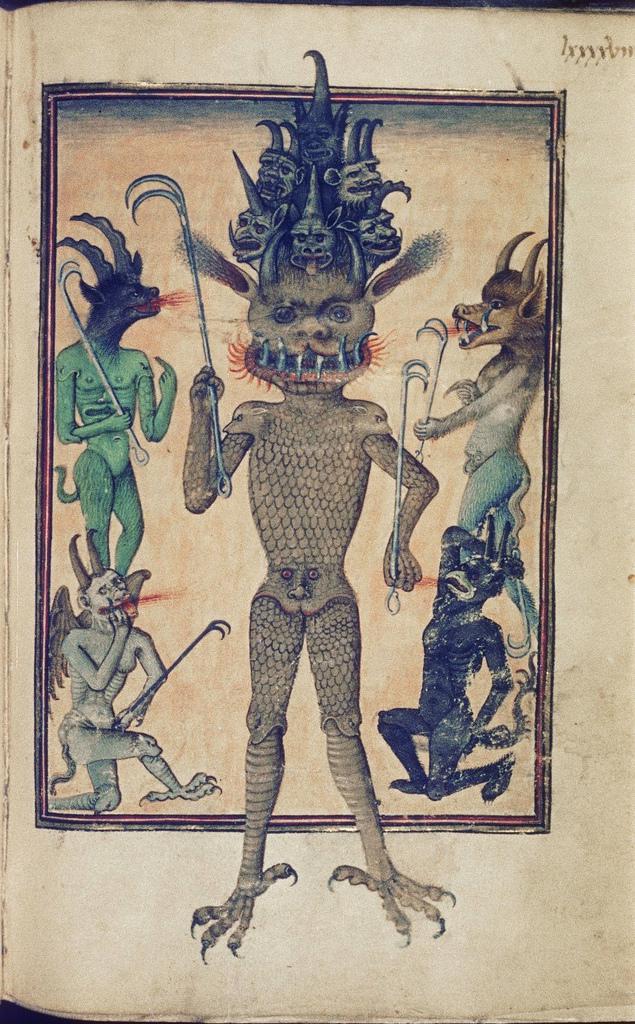
Image 012
La Vigne Nostre Seigneur
Sexuality and free spirited wickedness were symbolised through the use of the grotesque. Hooves, horns, claws and animal ears were used to show the wild, uncivilized, primal nature of the monstrous Demons. Large, mutant phalluses were used to show unstoppable lust, perversion, and sexuality. Human and animal faces appeared on unnatural hosts. Knees, elbows, stomachs, and most importantly, groins and anuses; all played host to tortured, ghastly faces. Especially upon depictions of Satan118. The groin face represented sex outside of that limited by Christian cultural doctrine, outside of marriage, uncivilized and barbaric. The anus faces symbolised trickery and lies. Nudity was used as a symbol of the barbaric. Humanity a Sin.
In depicting the Evils of Hell, these artists had free reign to create whichever horrors their imaginations could birth119. Each creation an artist makes reveals something to the audience about the artist, as, as Hepworth argued, artistic creation was the convergence of the conscious and unconscious minds120. In depicting the things which they were to repress, they were exploring those very acts within their fantasies. They were presenting their repressed desires, for the sole function of the repression of desire. Dreams are thought to be the allowance of the expression of repressed desire in a safe way to be processed by the mind121. Artists, such as the Surrealists, often sought to explore these realms as a way to express and discover repressed and hidden wonders of the self and the external reality. These precursors to the pioneering dream explorers sought instead to use their dreams to create fear and prostration. As the desire to dominate and control could be considered an Evil human trait, the artists, even if they sought to warn the populous with their work, could be considered the Uncanny Double of their future counterparts.
113 Ward, L. & Steeds, W. 2007. Page 11.
114 Vatican Archive, Catechism of the Catholic Church. Paragraph 7, The Fall.
http://www.vatican.va/archive/ENG0015/__P1C.HTM Section 401-408.
115 Ward, L. & Steeds, W. 2007. Page 49.
116 Ward, L. & Steeds, W. 2007. Page 9.
117 Freud, S. 1919 (in Freud, S. 2003 page 143).
118 Ward, L. & Steeds, W. 2007. Page 10,14,24,35,118,122.
119 Ward, L. & Steeds, W. 2007. Page 9-10.
120 Hepworth, B. 1937 (in Harrison, C. ed & Wood, P. ed 2003.)
121 Freud, S. (in Gay, P. ed. 1995).
113 Ward, L. & Steeds, W. 2007. Page 11.
114 Vatican Archive, Catechism of the Catholic Church. Paragraph 7, The Fall.
http://www.vatican.va/archive/ENG0015/__P1C.HTM Section 401-408.
115 Ward, L. & Steeds, W. 2007. Page 49.
116 Ward, L. & Steeds, W. 2007. Page 9.
117 Freud, S. 1919 (in Freud, S. 2003 page 143).
118 Ward, L. & Steeds, W. 2007. Page 10,14,24,35,118,122.
119 Ward, L. & Steeds, W. 2007. Page 9-10.
120 Hepworth, B. 1937 (in Harrison, C. ed & Wood, P. ed 2003.)
121 Freud, S. (in Gay, P. ed. 1995).
Conclusion
The Uncanny has a vast and profound impact upon human nature and evolution. Its grasp influences every aspect of contemporary culture. From the Enlightenment onwards, it has shaped the evolution of art and creative thinking, inspiring some of the most impacting artwork and creative endeavours mankind has seen. There is limitless scope in its depths, and it is a territory ripe for exploration by artists and critical thinkers in this new age. The age of the Uncanny.
Bibliography
Due to the nature of this content it is only viewable on Tablet or Desktop.
Bartneck, C., Kanda, T., Ishiguro, H., Hagita, N. (2007). Is the uncanny valley an uncanny cliff?, Proceedings of the 16th IEEE, RO-MAN 2007, [Online] 368-373. Available from: http://www.bartneck.de/publications/2007/uncannyCliff/index.html [Accessed 02 March 2010].
Bayley, S. 2007. Surreal things: surrealism and design, The Observer [Online]. Available from: http://www.guardian.co.uk/artanddesign/2007/mar/25/design.surrealismatthevanda [Accessed July 2010].
Brenton, H., Gillies, M., Ballin, D., Chatting, D. (2005) The uncanny valley: does it exist?, HCI, [Online] 1-4. Available from: http://homepage.mac.com/dave_chatting/BT/uncanny-valley-hci2005.pdf [Accessed 03 February 2010].
Bryant, D. The uncanny valley: why are monster-movies so horrifying and talking animals so fascinating? [Online]. Available from: http://www.arclight.net/~pdb/nonfiction/uncanny-valley.html [Accessed 09 January 2010].
Burgess, A. (1962) A Clockwork Orange. London, Penguin Group.
Canemaker, J. (2004). A part-human, part-cartoon species. The New York Times. Available from: http://www.nytimes.com/2004/10/03/movies/03cane.html [Accessed 22 February 2010].
Currie, N. (2004). The uncanny valley [Online]. Available from: http://imomus.livejournal.com/53978.html [Accessed 03 March 2010].
Danielewski, M. Z. (2001) House of Leaves. London, Doubleday
Eyre, S. (ed.), Page, R. (ed.). (2008) The New Uncanny; Tales of Unease. England, Comma Press.
Emery, N. J. (2000). The eyes have it: the neuroethology, function and evolution of social gaze, Neuroscience & Biobehavioral Reviews, [Online] 4 (6), 581-604. Available from: DOI 10.1016/s0149-7634 (00) 00025-7. ISSN 0149-7634. [Accessed 01 March 2010].
Ersotelos, N., Dong, F. (2008). Building highly realistic facial modelling and animation: a survey, The Visual Computer, [Online]. Available from: DOI 10.1007/s00371-007-0175-y [Accessed 20 February 2010].
Freud, S. 1920, Beyond the pleasure principle. In P. Gay, ed. The Freud reader. London: Vintage. 1995, pp. 594 – 626
Freud, S. 1900, The interpretation of dreams. In: P. Gay, ed. The Freud reader. London: Vintage. 1995, pp. 129 – 142
Freud, S. (1997) The Interpretation of Dreams. London (UK), Wordsworth Editions
ISBN: 978-1-85326-484-9
Freud, S. (2003) The Uncanny. London (UK), Penguin Books Ltd
ISBN: 978-0-14-118237-7
Giddon, D. B., Sconzo, R., Kinchen, J. A., & Evans, C. A. (1996). Quantitative comparison of computerized discrete and animated profile preferences. The Angle Orthodontist, 66(6), 441–448.
Gouskos, C. (2006). The depths of the uncanny valley. Game Spot [Online]. Available from: http://www.gamespot.com/features/6153667/index.html. [Accessed 25 February 2010].
Gray, J. (2008). Black Mass; Apocalyptic Religion and the Death of Utopia. London (UK), Penguin Book Group
ISBN: 978-0-713-99915-0
Green, R. D., MacDorman, K. F., Ho, C., Vasudevan, S. (2008) Sensitivity to the proportions of faces that vary in human likeness, Computers in Human Behavior, [Online] 24, 2456-2474. Available from: 10.1016/j.chb.2008.02.019 [Accessed 05 October 2009].
Harrison, C. ed., Wood, P. ed. (2003). Art in Theory 1900 – 2000: An Anthology of Changing Ideas. Oxford (UK), Blackwell Publishing
Hill, J. (2007). Heart-Shaped Box. London (UK), Gollancz
ISBN: 978-0-57507-912-0
Jentsch, E. (1997) On the psychology of the uncanny (1906), Angelaki, [Online] 2, 1, 7-16. Available from: 10.1080/09697259708571910 [Accessed 19 October 2009].
Lanza, M. (2000) The Living Dead; Inside the Palmero Crypt. London (UK), Westzone Publishing Ltd
Lehman, P., Luhr, W. (2003). Thinking About Movies: Watching, Questioning, Enjoying. London (UK), Blackwell
MacDorman, K. F., Green, R. D., Ho, C., Koch, C. T. (2009) Too real for comfort? Uncanny responses to computer generated faces, Computers in Human Behavior, [Online] 25, 695-710. Available from: doi:10.1016/j.chb.2008.12.026 [Accessed 20 February 2010).
MacMillan, D. (2007). Navigating the uncanny valley. Business Week [Online]. Available from:http://businessweek.com/innovate/content/aug2007/id20070817_955317.htm [Accessed 02 March 2010].
Manzano, Ö. d., Cervenka, S., Karabanov, A., Farde, L., Ullén, F. (2010) Thinking outside a less intact box: thalamic dopamine d2 receptor densities are negatively related to psychometric creativity in healthy individuals. PloS ONE, [Online] 5 (5), e10670. Available from: http://www.plosone.org/article/info:doi/10.1371/journal.pone.0010670 doi: 10.1371/journal.pone.0010670 [Accessed July 2010].
McGinn, C. (2008). Mindfucking; a Critique of Mental Manipulation. Stocksfield (UK), Acumen Publishing Ltd
ISBN: 978-1-84465-114-6
Mori, M. (translated by MacDorman, K. F., Minato, T.) (1970) Bukimi no tani[The uncanny valley], Energy, [Online] 7 (4), 33-35. Available from: http://www.androidscience.com/theuncannyvalley/proceedings2005/uncannyvalley.html [Accessed 18 February 2010].
Noh, J. (NO DATE). A survey of facial modelling and animation techniques, Integrated Media Systems Center, University of Southern California. [Online]. Available from: http://citeseerx.ist.psu.edu/viewdoc/download;jsessionid=98CC27941468BD34551DA0931C5ED5FA?doi=10.1.1.23.7475&rep=rep1&type=pdf [Accessed 01 March 2010].
North, S. (2010). The secrets of “psycho’s” shower scene, Film Salon [Online]. Available from: http://www.salon.com/entertainment/movies/film_salon/2010/06/25/psycho_shower_scene_anniversary [Accessed July 2010].
Rich, C., Sidner, C. L. (2009) Robots and avatars as hosts, advisors, companions, and jesters, AI Magazine [Online] Spring, 29-41. Available from: http://web.cs.wpi.edu/~rich/aimag/RichSidner09.pdf [Accessed 23 March 2010].
Rodley, C. (ed.) (1999). Lynch on Lynch. England (UK), Faber and Faber Ltd
ISBN: 0-571-19548-2
Royle, N. (2003). The Uncanny. Manchester (UK), Manchester University Press
ISBN: 978-0-7190-5561-4
Stewart, S. (1982) The epistemology of the horror story, The Journal of American Folklore, [Online] 95, 375, 33-50. Available from: http://www.jstor.org/stable/540021 [Accessed 22 October 2009].
Steckenfinger, S. A., Ghazanfar, A. A. (2009) Monkey visual behavior falls into the uncanny valley, Proceedings of the National Academy of Sciences of the United States of America [Online] 106 (43), 18362-18366. Available from: www.pnas.org/cgi/doi/10.1073/pnas.0910063106 [Accessed 24 March 2010].
Thompson, C. (2004). The undead zone: why realistic graphics make humans look creepy. Slate [Online]. Available from: http://slate.msn.com/id/2102086 [Accessed 03 March 2010].
Thrill, S. (2010). Giger Timeline. Wired [Online]. Available from: http://www.wired.com/thisdayintech/2010/02/0205hr-giger-born-science-fiction-artist/ [Accessed July 2010].
Tronstadt, R. (2008). The uncanny in new media art, Leonardo Electronic Almanac, [Online]. Available from: http://www.leonardo.info/LEA/PerthDAC/RTronstad_LEA160203.pdf [Accessed 10 March 2010].
Tudor, A. (1997) Why horror? the peculiar pleasures of a popular genre, Cultural Studies, [Online] 11(3), 443-463. Available from: http://pdfserve.informaworld.com.libproxy.dundee.ac.uk/598369_731562218_738578330.pdf [Accessed 22 October 2009].
Tythacott, L. (2003) Surrealism and the Exotic. New York (USA), Routledge ISBN: 0-415-27637-3
Warner, M. (2006). Phantasmagoria. Oxford (UK), Oxford University Press
ISBN: 978-0-19-923923-8
Ward, L., Steeds, W. (2007). Demons; Visions of Evil in Art. London (UK), Carlton Books Limited ISBN: 978 1 84442 098 8
Youmans, W. J. ed. (1896) Popular Science, November 1895 – April 1896 [Online]. Available from: Google Books. [Accessed July 2010].
Willis, J., Todorov, A. (2006). First impressions: making up your mind after a 100-ms exposure to a face, Association for Psychological Science., [Online] 17 (7), 592-598. Available from: http://www.princeton.edu/~atodorov/Publications/Willis&Todorov-PsychScience.pdf [Accessed 07 March 2010].
Weschler, L. (2002). Why is this man smiling? Digital animators are closing in on the complex system that makes a face come alive. Wired [Online] 10.06. Available from: http://www.wired.com/wired/archive/10.06/face.html [Accessed 08 March 2010].
Wood, C. (1999). Evoking the uncanny that lies behind the reality. The Lancet [Online] 355, 1890. Available from: DOI: 10.1016/S0140-6736(05)75103-5 [Accessed 10 December 2009].
Yang, X., Southern, R., Zhang, J. J. (2009). Fast simulation of skin sliding, Journal of Visualization and Computer Animation [Online] 20, 333-342. Available from: http://eprints.bournemouth.ac.uk/10615/2/skinslide.pdf [Accessed 04 March 2010].
Filmography
Due to the nature of this content it is only viewable on Tablet or Desktop.
π, 1998. [Film] Aronofsky, D. USA: Harvest Filmworks
Avatar, 2009. [Film] Cameron, J. USA: Twentieth Century Fox Film Corporation
Being John Malkovich, 1999. [DVD] Jonze, S. USA: Grammercy Pictures (I)
Beowolf, 2007. [DVD] Zemeckis, R. USA: ImageMovers
Child of Darkness, Child of Light, 1991. [Film] Sargenti, M. USA: G.C. Group
Critters, 1986. [Film] Herek, S. USA: New Line Cinema
Dark City, 1998. [Film] Proyas, A. Australia / USA: Mystery Clock Cinema
Dead Ringers, 1988. [DVD] Cronenberg, D. Canada: Mantle Clinic II
Eraserhead, 1976. [DVD] Lynch, D. USA: American Film Institute (AFI)
Face / Off, 1997. [Film] Woo, J. USA: Touchstone Pictures
Franklyn, 2008. [Film] McMorrow, G. France / UK: Recorded Picture Company (RPC)
Jaws, 1975. [Film] Spielberg, S. USA: Universal Pictures
La cité des enfants perdus, 1995. [Film] Caro, M., Jeunet, J.-P. France / Germany / Spain: Club d’Investissement Média
Land of the Dead, 2005. [DVD] Romero, G. A. Canada / France / USA: Universal Pictures
Mirrormask, 2005. [Film] McKean, D. UK / USA: Jim Henson Productions
Mirrors, 2008. [Film] Aja, A. USA: Regency Enterprises
Multiplicity, 1996. [Film] Ramis, H. USA: Columbia Pictures Corporation
Mrs Doubtfire, 1993. [Film] Columbus, C. USA: Blue Wolf
Naked Lunch, 1991. [DVD] Cronenberg, D. Canada: Film Trustees Ltd
Perfect Blue, 1998. [Film] Kon, S. Japan: Rex Entertainment
Psycho, 1960. [Film] Hitchcock, A. USA: Shamley Productions
Sleeping with the Enemy, 1991. [Film] Ruben, J. USA: Twentieth Century Fox Film Corporation
The 6th Day, 2000. [Film] Spottiswoode, R. USA: Pheonix Pictures
The Blair Witch Project, 1999. [Film] Myrick, D., Sánchez, E. USA: Haxan Films
The Cook, the Thief, His Wife, and Her Lover, 1989. [DVD] Greenaway, P. France / UK: Allarts Cook
The Descent, 2005. [Film] Marshall, N. UK: Celador Films
The Elephant Man, 1980. [DVD] Lynch, D. USA: Brooksfilms
The Jacket, 2005. [Film] Maybury, J. USA / Germany: Mandalay Pictures
The Shining, 1980. [DVD] Kubrick, S. UK / USA: Warner Bros. Pictures
Images
Due to the nature of this content it is only viewable on Tablet or Desktop.