
The Uncanny in Narrative Arts
Christopher Lawton
Msc Media Arts & Imaging: 3d Computer Animation
2010 Pg Dip Report
Duncan of Jordanstone College of Art & Design
Abstract
The Uncanny is a phenomenon of words(1), of storytelling and literature(2), of psychological drives, psychoanalytic studies and philosophy(3), of robotics(4), film, art(5), and animation(6). It is a phenomenon of perception, intellect, dreams, experience, confusion and revelation. The fantastic and the everyday, the grotesque and the sublime. It repeats and controls, it drives and compels. It tricks and speaks truths. It is the illuminated repressed. It is the self and the other(7).
The phenomenon is unique to everyone in its own way. Not only is the Uncanny a fundamental human experience, it is an extremely powerful creative tool(8). However, just as easily as it can create a far reaching, powerful emotive narrative experience within an audience, it can also creep in to a work and destroy it(9). This research work seeks to explore the significance of the Uncanny, and its importance to contemporary culture my own work. It is intended to serve as an introduction to the themes and production of the Masters Project and Msc Report.
Introduction
As an artist and consumer, I am frequently drawn towards situations, art, and narratives of Uncanny nature. Prolific throughout my adult life, it provides the thematic content of my works. However, given that my primary focus circles 3D Computer Graphics, the Uncanny is not only key thematically, but also impacts upon the execution and reception of my work. The Uncanny phenomenon has far reaching and profound impact on humanity. It is a survival mechanism(10), storytelling device, and a fundamental element of contemporary life(11).
The Uncanny Narrative Tropes(12), and the Uncanny Valley(13), both impact significantly upon my artistic practice. This report will form the introduction to the themes of the Msc Report, wherein my personal practice, and influences, will be discussed at length. This discussion introduces these topics, and their relationship to contemporary narrative art and culture.
Firstly, the Uncanny as a psychoanalytic concept will be discussed, examining the origins of Uncanny theory, and its relevance to culture. Uncanny Narrative Tropes follows, grouped by closely related Tropes because they rarely operate in isolation.
Next, the Uncanny Valley will be introduced, highlighting its importance to my work as an artist. Fuller discussion will be made in the Msc Report, as it is tied both to the themes and execution of the Masters Project.
Lastly, an introduction to the Uncanny nature of cinema and animation, before exploring the defining Uncanny event of contemporary history. Analysis of certain works which highlight the topics of this report can be found in the Appendices.
The Phenomenon of the Uncanny
The Uncanny was introduced to psychoanalysis by Ernst Jentsch with On the Psychology of the Uncanny(14) (OTPOTU), before being popularised by Freud in The Uncanny(15). Both thought differently about its nature and cause.
Jentsch focused upon the Uncanniness of intellectual uncertainty; not its nature, but its cause. He proposed the root cause was difficulty of the brain assimilating new knowledge of situation, experience or phenomena(16). Misoneism, dislike of novelty, relates to resistance the brain must overcome to accept knew knowledge or stimulus. Negative response to this, he believed, created the Uncanny effect.
He believed the Uncanny originated in the way which mankind assumes the exterior world is relative to one’s own reality. In this way, he suggested children speak to inanimate objects as if they were animate. Also, he believed this could be the origin of the notion of demons(17), that mankind has projected itself into the reality around it, shaping their perception so that the world mirrors themselves.
If fear objects are internalized and personalised, the correct elements surfacing could create an uncanny terror. The victim doesn’t realize the source of the fear, or why they are afraid. Sometimes it is impossible for someone to eliminate their fears, as they are from within, not without. As Jentsch put it, “he is not always capable of exorcising the spirits which were created out of his own head from that very head(18).“
Aside from the day to day intellectual uncertainties, sensory deprivation, loss, or alteration (e.g. drug use), Jentsch illuminated the Uncanny sensations often caused through narrative art. This has been found dating back to at least the Enlightenment(19).
An Uncanny repetitious revelation, Freud’s reassessment unearthed vast complexity, which Jentsch’s limited intellectual uncertainty argument could not. The legacy of Freud’s masterwork provides the major influence for the discussions of this work. This too, makes it the legacy of Jentsch. For, without OTPOTU, the echoes of Freudian Uncanny theory wouldn’t have rippled into the collective contemporary conscious(20). An interesting note, raised by many discussing Freud’s Uncanny, is that every reading brings a fresh interpretation of what he did or didn’t mean. Nothing is set in stone, and its fluidity it will continue to inspire fresh thinking(21).
Freud believed the Uncanny more complex than his predecessor. Though sometimes disagreeing, he believed the Uncanny was linked to primitive man. It wasn’t a fear of the unknown or novel stimulus, much the opposite in fact. The Freudian Uncanny is “species of the frightening that goes back to what was once known and had long been familiar(22).” It is the return of the repressed(23).
Freud expanded the discussion of Uncanny terminology, searching for its definition in several languages, finding das Unheimlich non-existent in many languages(24). This is interesting, as the Uncanny appears not only to cross culture, but cross species(25).
The Uncanny shared a relationship with humanity, according to Jentsch, since humanity began. He concluded that the Uncanny sensation is part of a defensive mechanism, there to help humanity remain on top of the food chain(26). This mechanism spurs on the development of thinking and learning through avoidance of what Freud termed the unpleasurable(27).
Future thinking on the works of the pioneering psychoanalysts has taken the discussion to even greater depths. Royle, in 2003, suggested that the Uncanny was not what everyone had been taking it for. He believed the Uncanny was a “sense of ourselves as double, split, at odds with ourselves(28). To Royle, the Uncanny was fundamental to the future development of humanity and human feeling.
Uncanny Narrative Tropes
Part of the Freudian legacy is the discussion of the Uncanny narrative tropes. Often, a combination can be found in the works of artists(29) and storytellers(30), in theme or creative practice.
Blind, Buried Alive, & the Death Drive
We all possess a drive to death, an Uncanny urge for oblivion(31), flying in the face of the human urge to procreate and to prosper. These drives take the narrative forms of Eros and Thanatos, the gods of sex and death, or as Royle puts it, the instincts of life and death(32). The two instinctual drives of humanity appear at odds with one another, however this may not be the case(33). If, as D. H. Lawrence said, “We cannot admit the desire of death in ourselves, even when it is single and dominant. We must deceive ourselves in the name of life(34),” if something reminds us of this urge, it could create an Uncanny phenomenon.
The Death Drive permeates every aspect of the Uncanny, and is strongly tied to Blindness and being Buried Alive. Blindness, linked to castration through the tale of Oedipus, was discussed at length by Freud. The eye was linked to the phallus in the language of dreams. This meant that the fear of being blinded was actually a fear of being castrated, cut off from procreation(35). Blindness is a trope often found in narrative arts used to profoundly disturb the audience. Literature is often home to this trope, with examples such as House of Leaves(36) and Heart Shaped Box(37) each interpreting the theme differently. House of Leaves builds a sense of overwhelming darkness eventually overcoming its cast. Heart Shaped Box uses the device of ghosts having their eyes removed, as if scribbled over with marker pens, relating death to great blindness and oblivion. Cinematic representation of the trope of blindness often takes the form of darkness(38) or the pitch black depths of a cavernous landscape(39).
How It Is(40) explored the tropes of blindness and buried alive, inviting the audience to enter a monolithic black void. Being buried alive seems to be the perfect death drive trope. To Freud, it was the most Uncanny of them all. His reasoning was astute. The Uncanny is the overlapping boundaries of reality and fantasy. Confrontation with something once considered imaginary, as a reality, causes that thing to take on the “full function and significance of what it symbolizes(41).” To Freud, this signified a desire to return to the womb, creating an Uncanny sensation, within men specifically, upon contemplating female genitalia. In this study, premature burial is taken as expression of the instinctual drive towards oblivion.
The Double, Coincidence, & Repetition
The Double is one of the most common Uncanny tropes found in cinematic narrative(42). It is also the trope most likely to cause the Uncanny Valley effect. The notion of the double goes hand in hand with coincidence and repetition. Freud himself described his disgust upon noticing that he had apparently (on first glance) signed himself into his surgery(43).
The term for this is the Doppelgänger(44) effect, wherein a person meets their own double, or sees the double of someone else. The Uncanny effect is strongest when meeting ones own double, especially if that individual knows for certain there is only the one of them. This is likely related to the Uncanny as a survival mechanism.
The Double also relates to identical twins, which are often used to startling effect in cinema. Sculpture and waxworks are prone to creating a sense of the Uncanny through the Uncanny Valley effect, which is enhanced by the Doppelgänger effect in the likes of Madame Tussauds waxworks of the famous and the dead.
Freud noted that in ancient Egyptian culture it was common for an effigy of the dead to be created using materials which would stand the test of time. This stemmed, he believed, from a narcissistic wish to live forever, and belief that this practice would help them to do so. Instead, the statues managed only to act as an “Uncanny harbinger of death(45)”. Freud also asserted that demons are the gods of fallen cults, their Uncanny double.
Repetition and coincidence are fundamental to the Uncanny, although Freud accepted they would not compel a reaction in all people, or at all times(46). If, according to Freud, we are driven to remember our instinctual impulses of repetition, it can create an Uncanny perception. This could be a repetitious action within ourselves(47), a repetitious thought, or external repetition. For example, consistently seeing the same number over and over again(48), emergent patterns in nature(49), or the repetition of an event significant or insignificant(50). The interval between the repetitions could influence the strength of the Uncanny event, depending on the significance of the event in repetition.
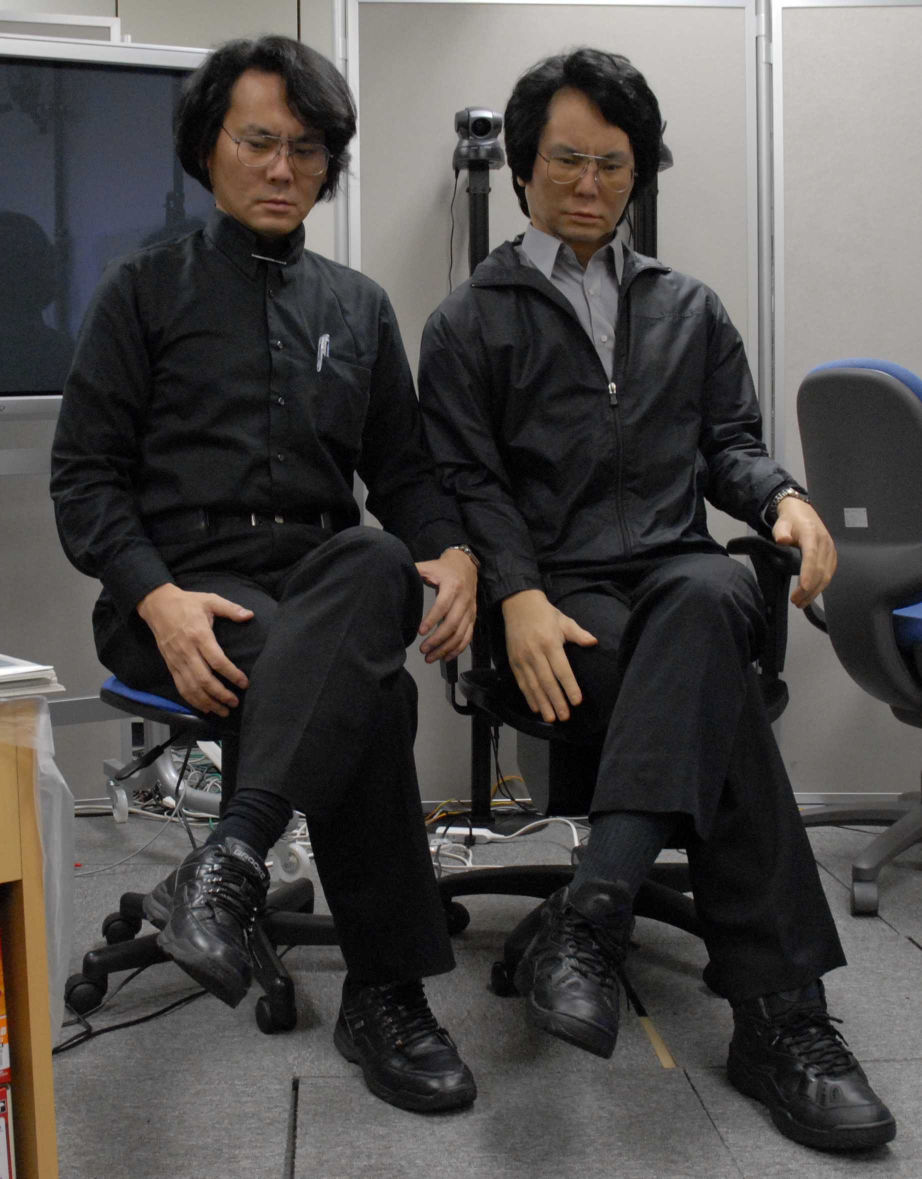
Geminoid & Creator Hiroshi Ishiguro
Inanimate Animate, Animate Inanimate, & Control
A compulsion of disgust emanates from confusion between the animate or inanimate nature of an object or entity. Jentsch gave example of a traveller whom sat upon a snake thinking it was a tree root(51). The instant before seeing the snake, the fear is of Uncanny nature, not one of mortality. To the traveller, the tree moved in an animate and considered fashion. Experience dictates this cannot happen, creating an Uncanny horror.
Uncanny events can be caused by observation of phenomena like trances and epileptic fits(52). Exposure to man as a broken down machine, stuttering, shaking, without indication of intentional input can cause great distress. Anything which removes illusion of free will(53) can create Uncanny disturbance. One fundamental human characteristic is the belief in free will, control over ones own thoughts and actions. Uncanny events like this remind us, free will isn’t certain.
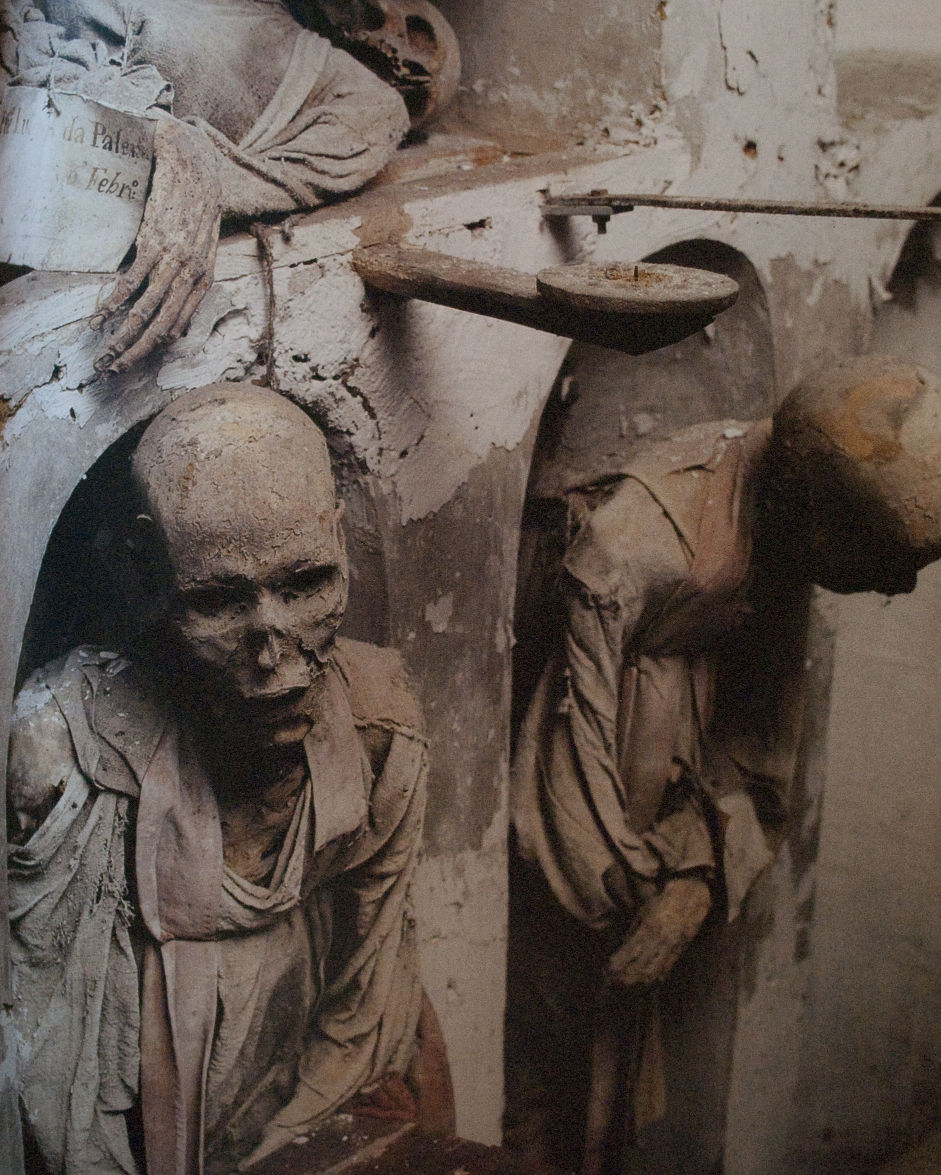
One sight which often produces Uncanny response is that of the dead, due to the preconception that the corpse is animate(54). Vision of the dead can stir reminders that we will also one day die, that our mechanical clock will cease to tick, that our cpu will stop sending out signals. We will become an Uncanny echo of ourselves, human only in appearance. We are reminded of our mechanical transience, by the potential of the broken machine before us of stirring back into being as fleshy automata.
From
The Living Dead; Inside the Palmero Crypt.
The Uncanny Valley
The Uncanny Valley is a contemporary term, for an age old phenomenon. Coined by Masahiro Mori in 1970(55) in explaining the Uncanny phenomena of humanoid robotics, it has relevance far outside the field. From traditional puppetry and dolls, to cutting edge computer graphics, it is a phenomenon wherein the closer to full realism an automata, doll, avatar or robot become, the more eerie and disturbing they become to the viewer(56). Especially in motion.
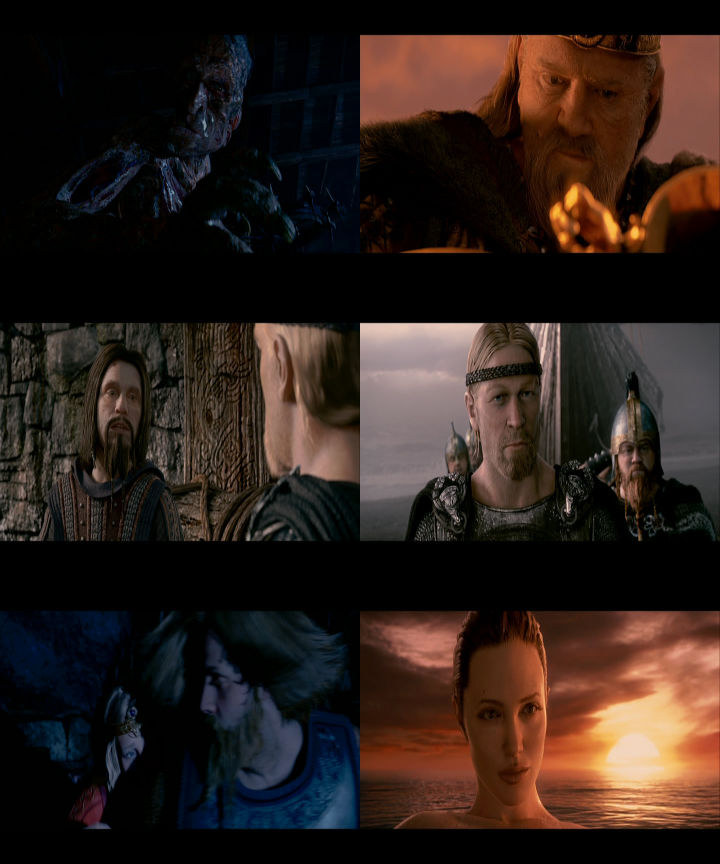
Beowolf (2007)
The Uncanny Valley is worthy of discussion on another level. The primary reason for studying the Uncanny Valley is to further robotics and Human Computer Interface (HCI) technology. This means the focus is upon finding ways in which to avoid this phenomenon occurring(57). Films, such as Beowolf (2007) fell into the Uncanny Valley, wherein the 3D animated characters at points appeared realistic and in the same instance entirely unrealistic. They appeared as zombies, without trace of humanity.
Examples can be found in art(58) and photography(59) utilizing the Uncanny Valley to great effect. Creative use of the otherwise destructive force of the Uncanny Valley will form part of the Msc Project and Report. Within commercial art industries, the Uncanny Valley effect has negative connotations, and could impact on sales or engagement of works. However, clever use can do the reverse. The horror genre often uses the Uncanny Valley for impact.
To create an animated project which engages through the Uncanny Valley, specific technical problems must be overcome. For example, both photo-realistic texturing and realistic shaders must be created, and real world lighting must translated into render controls. This will be discussed in the Msc Report.
Animating the Dead - Cinema & Animation
Cinema holds a special relationship with the Uncanny, which is discussed at length by Laura Mulvey in Death 24x a Second; Stillness and the Moving Image(60). She contemplates the draw mankind has to illusions, our willingness to be fooled, from ancient magic to contemporary cinema. The Uncanny basis of cinema is that it reanimates the dead.
To Mulvey, the traditional photographic index, “a material trace that can be left without human intervention, is a property of the camera machine and the chemical impact of light on film(61).” binds the essence movement and life. This is more confusing to the spectator than chancing upon relics of ages past, as the contents are constantly in the present. The camera catches not life, but the ghost of what once was, in the instant the image was taken. The photograph captures image of death and the dead.
Film, conversely, reanimates images of the dead, granting the illusion of life through optical trickery. The imitation of life, Uncanny to the core. A further premise raised by Mulvey is that with contemporary technology this Uncanny spectre is stronger, as not only because an audience can still the image in a way they never could before, back to the original photograph. With digital technology the Index no longer registers on a physical object. It becomes a ghost in the machine that never truly existed, realised and brought to life through illusion. Although these arguments could be contested, they provide an interesting platform for reflection.
Could the Uncanny nature of animation, especially its relation with the Uncanny Valley, have a deeper root cause than purely the realism matched with insufficient animation? Is it possible that with the greater realism with the visuals in the still image, on animation we are faced with the ghosts of things that never existed except within our minds; ghosts that appear as real as our own deathly cinematic shadows?
Terror & the Mindfuck - the Uncanny Apocalypse

Plane Hits WTC South Tower
On September 11th 2001 a new age dawned. The twin towers of the World Trade Center collapsed, having been struck one after the other by passenger aircraft. First thought an accident, until the Uncanny echo confirmed that the USA, and “freedom”, were under attack. This event was repeated, over, and over, around the world, for hours thereafter. Royle talks of the Uncanny voice recordings of the dead and the dying(62) (audio recording in a similar manner to film).
Adding to the Uncanniness of this event was knowledge that thousands of people were being buried alive, with no hope of rescue. There was no knowledge at this point of who the enemy was. All that was known, was that the western world and way of life was under attack.
The iconic towers had been a major part of the New York skyline, featuring in many films shot in the city. Watching the tragedy unfold, the viewer could be forgiven for thinking that they were watching a film(63). Repeatedly, the world watched the towers fall, the surrounding area of New York become buried in ash.
The world stood still to watch the greatest mindfuck(64) of the new Millennium. This event was the catalyst of the new apocalypse. To some, the apocalypse means the end of the world. For many that day, it was. An apocalypse is not merely the end of the world, it is the end of an age of thinking. It is an event of illumination(65), the signifier of a new era.
As innocents crashed, burned and jumped from the great capitalist monoliths, their essence was captured on camera for the world to see. The death of death was recorded, ghosts trapped in their technological prisons, twenty four times a second as they died. They wait there, only to have their final moments reanimated, paused, sped up and rewound at the whim of the viewer.
Conclusion
The Uncanny has been considered by humanity since the age of Enlightenment. It is ingrained in everything we do as a species, and everything we do as individuals. When the towers fell this author was preparing to start afresh in an institution of higher learning. The event has subconsciously shaped the very focus of these studies, leading up to this point. This Uncanny guidance will continue far into the future, affecting all my future artwork, research and writing. The Master’s Project and Msc Report will explore my personal relationship to the Uncanny, through both its themes and the theoretic and practical execution of the project itself.
To this author, whom still remembers vividly looping the horrors of September 11th 2001, we have entered a new age, that of the Uncanny.
Appendices
Appendix A
Dead Ringers
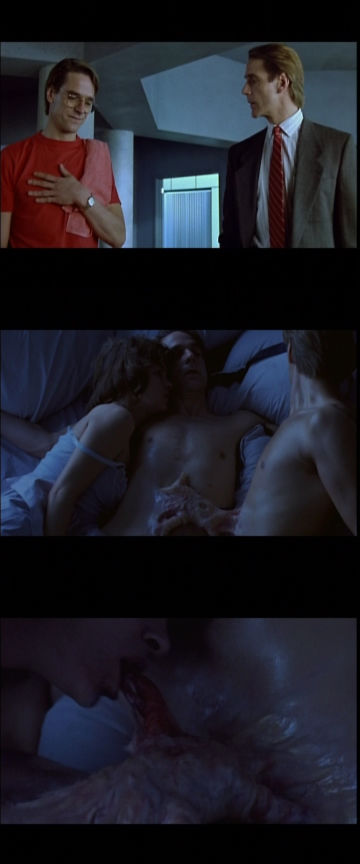
Dead Ringers (1988)
One example of the Double in Narrative Arts is the psychological thriller Dead Ringers(66), which delves so deeply into the Uncanny that it enters the realm of the cinematic mindfuck(67).
The plot centres around identical twin brothers whom work as gynaecologists. They share patients and women without anyone realising what they are doing. However, one particular woman drives a wedge between the brothers. This split is represented by an Uncanny nightmare wherein the brothers share a synergy of flesh cannibalised by their love object.
This sequence introduces two more Uncanny tropes to the film, the combination of the three driving the disturbing nature of the scene home. These are the tropes of Cannibalism and that of Confusion, Reality, Dreams, and Illusion. As the main characters are twins who grew up together, sharing everything(68), the doppelgänger effect would not apply to them. However, it does apply to the woman who tears them apart, when she discovers that she is not in a relationship with one man, but two. Her experience is that of confusion about the reality of her situation, as she slowly realises that all is not what it seemed.
Being John Malkovich
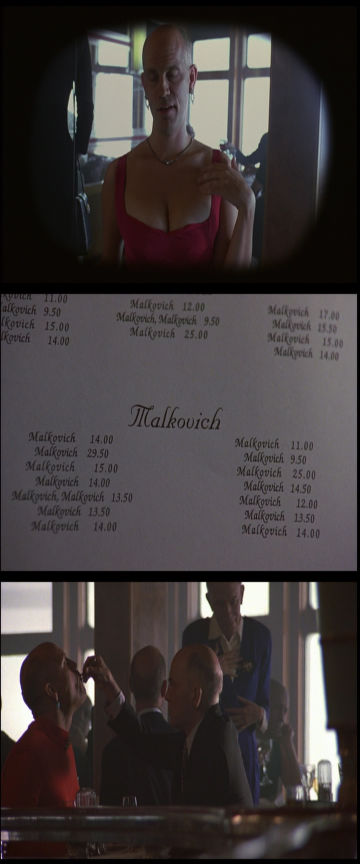
Being John Malkovich (1999)
A further example of the Double being put to powerful use is in the climactic section of Being John Malkovich. John Malkovich has entered the portal into his own mind, and opens his eyes. Reality, as far as he knows it, is broken in that instant. Everyone is John Malkovich. The only word they use is “Malkovich”. This also helps to further the other Uncanny tropes of the film, such as Malkovich being controlled by a puppeteer.
The effect of this sequence is one of absurdity, and terror. Malkovich appears to have gone insane, wherein his superego has been sidestepped granting his ego entry into the realm of the id(69). The “Malkovichs” are the many facets of his personality, once repressed and now come to light. This sequence is an audio-visual tour de force in the representation of the loss of control of the self through introspection.
The Shining
The Shining contains almost every Uncanny trope. The film itself tells the story of a man’s descent into madness and ensuing attempt to murder his family. However, it is also a ghost story, and is firmly based around the concept of repetition. The hotel where the film is set was the site of a massacre years before, where the old caretaker butchered his family with an axe, an act the new family seems doomed to repeat. This study will examine a few key sequences and their relation to the Uncanny.
“A Bloody Vision”
The first elevator sequence hints at the bloodshed of the past, and its future repetition. The boy, Danny, is psychic(70), and throughout the film sees ghosts and visions from the hotel. The first of these, before they move to the hotel, is a cinema icon. The red doors of the elevators open, spewing forth a river of blood. A quick flashing image of twin girls before a cut to Danny screaming in silence in the dark. He is wearing the clothes which he wears at the end of the film. This sequence sets up the sense of foreboding in a visceral and disturbing manner. Later repetition signifies the onset of the madness.
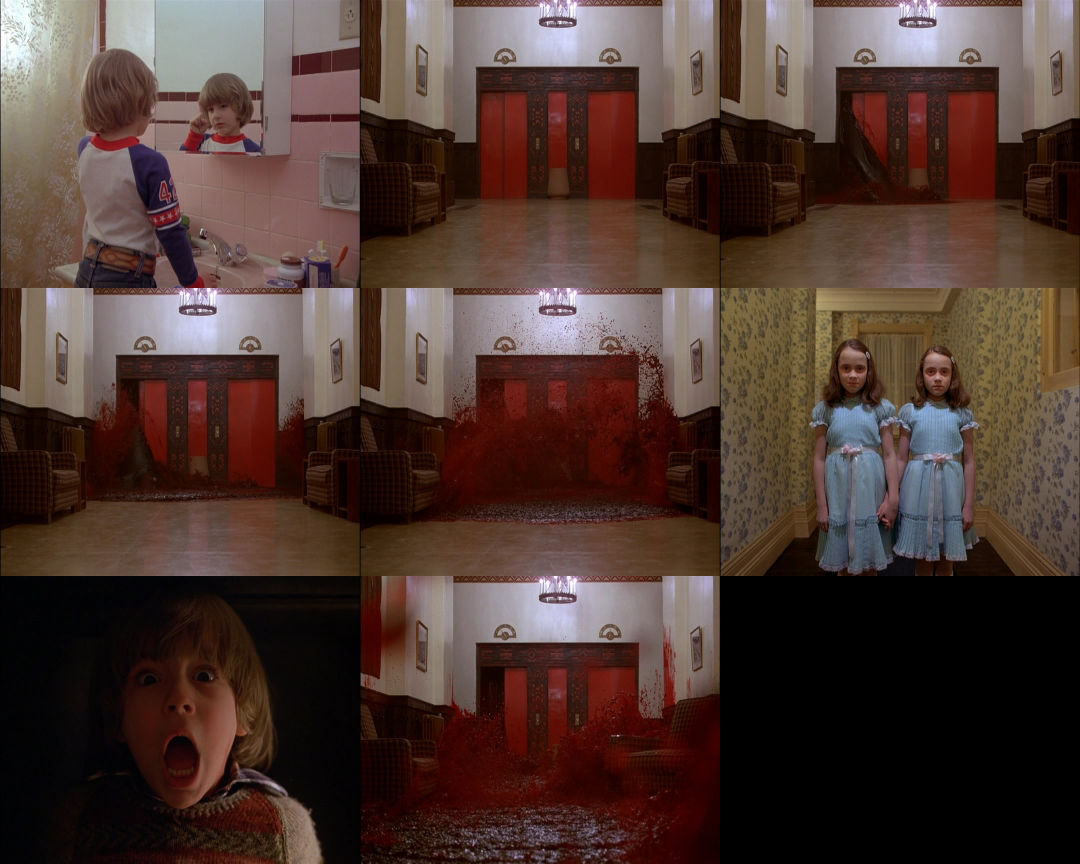
The Shining (1980)
A point of note is the sheer repetition in the visuals. The architecture of the hotel is repetitive and labyrinthine. Every detail is repetitive, from the design of the elevator doors and placement of pictures on the walls to the checker patterns on the furniture and the patterned wallpaper. Identical twins wearing identical clothes. The patterned clothing of Danny and his father. The signifier of his father’s descent into madness is the repetition of words on a typewriter(71) – the original source of the Uncanny in thought itself being language.
“Come and Play”
In the space of one minute, there are 18 repetitive cuts as shown below. Note also the repetition of the scenery along the perspective lines of the composition. The visual content speaks for itself, however the dialogue is also of great importance. Over and over, the girls invite Danny to come and play with them. This is an invitation to die, and the first time Danny has come face to face properly with the subject of his earlier vision. Notice that the same shot is used for the girls in the first sequence discussed. This helps to strengthen the Uncanny repetition as it signifies not only to Danny, but to the audience itself that something bad has happened, and is about to happen again. It is also the point where the lines between reality and fantasy begin to blur.
Appendix B
Cannibalism
Linked to the primary Uncanny Narrative Tropes is that of Cannibalism. A primitive animistic element of humanity, cannibalism has become an ultimate taboo. Things that remind us that we are capable of this act on a primitive level(72) can create an Uncanny revulsion as the repressed is brought back to light. The popular imagination is captivated by tales of Uncanny terrors, such as those of vampires and zombies. These contain a twofold Uncanniness. Firstly, they illuminate our cannibalistic potential, secondly, they are the reanimated dead. Zombies in particular flaunt this secondary Uncanny trait further by apparently having no mental capacity, being mere flesh eating automata.
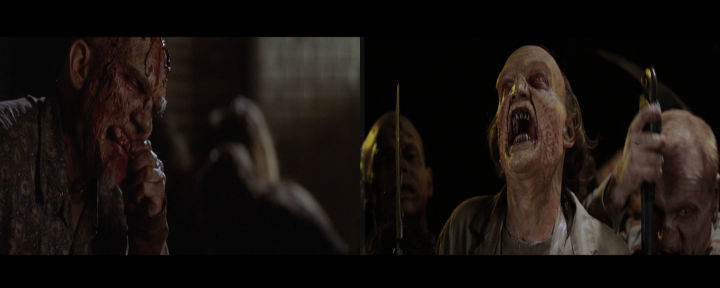
Land of the Dead (2005)
Cannibalism can be pushed to further effect than that of imaginary creatures. The Cook, the Thief, His Wife, and Her Lover(73) was a shining example of the power of the Uncanny tropes in emotive storytelling. The film itself is a visual feast, befitting its subject matter(74). The antagonist, Albert Spica, is a murderous, despicable man. He is driven to consume everything and every one around him. The primary setting for the film is in his restaurant, and throughout the film the themes of sex and death are juxtaposed to spectacular visual effect. The climax centres around the murder of his wife’s quiet, peaceful lover, and the revenge sought by her.
At the films end, she has rallied all those whom he has wronged, and they prepare Spica one last supper. His meal (shown below) is the lovingly prepared and meticulously presented body of the lover. Faced with this sight he proclaims his disgust, only to be reminded of his past vow to kill and eat the man. His wife encourages to eat the penis, as it is a delicacy, tapping into the fear of castration Freud linked to the Uncanny. At this point the horror of what is happening truly hits home for Spica, whom instead opts to eat a piece of abdominal tissue, the thought making him sick. The brutal, unforgiving and sadistic life he had led has now turned upon him. He eats the flesh of his victim, before being shot in the head by his wife. Before the curtains close to end the film(75) his wife utters the final word, which sums up Spica, and the power and dominance often sought by man. “Cannibal.”
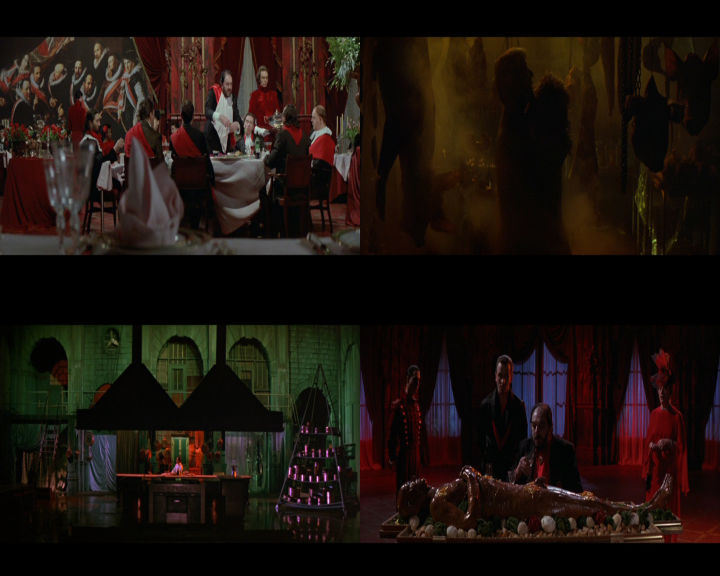
The Cook, the Thief, His Wife, and Her Lover (1989)
Bibliography
Due to the nature of this content it is only viewable on Tablet or Desktop.
Bartneck, C., Kanda, T., Ishiguro, H., Hagita, N. (2007). Is the uncanny valley an uncanny cliff?, Proceedings of the 16th IEEE, RO-MAN 2007, [Online] 368-373. Available from: http://www.bartneck.de/publications/2007/uncannyCliff/index.html [Accessed 02 March 2010].
Brenton, H., Gillies, M., Ballin, D., Chatting, D. (2005) The uncanny valley: does it exist?, HCI, [Online] 1-4. Available from: http://homepage.mac.com/dave_chatting/BT/uncanny-valley-hci2005.pdf [Accessed 03 February 2010].
Bryant, D. The uncanny valley: why are monster-movies so horrifying and talking animals so fascinating? [Online]. Available from: http://www.arclight.net/~pdb/nonfiction/uncanny-valley.html [Accessed 09 January 2010].
Burgess, A. (1962) A Clockwork Orange. London, Penguin Group.
Canemaker, J. (2004). A part-human, part-cartoon species. The New York Times. Available from: http://www.nytimes.com/2004/10/03/movies/03cane.html [Accessed 22 February 2010].
Currie, N. (2004). The uncanny valley [Online]. Available from: http://imomus.livejournal.com/53978.html [Accessed 03 March 2010].
Danielewski, M. Z. (2001) House of Leaves. London, Doubleday
Eyre, S. (ed.), Page, R. (ed.). (2008) The New Uncanny; Tales of Unease. England, Comma Press.
Emery, N. J. (2000). The eyes have it: the neuroethology, function and evolution of social gaze, Neuroscience & Biobehavioral Reviews, [Online] 4 (6), 581-604. Available from: DOI 10.1016/s0149-7634 (00) 00025-7. ISSN 0149-7634. [Accessed 01 March 2010].
Ersotelos, N., Dong, F. (2008). Building highly realistic facial modelling and animation: a survey, The Visual Computer, [Online]. Available from: DOI 10.1007/s00371-007-0175-y [Accessed 20 February 2010].
Freud, S. 1920, Beyond the pleasure principle. In P. Gay, ed. The Freud reader. London: Vintage. 1995, pp. 594 – 626
Freud, S. 1900, The interpretation of dreams. In: P. Gay, ed. The Freud reader. London: Vintage. 1995, pp. 129 – 142
Freud, S. (1997) The Interpretation of Dreams. London (UK), Wordsworth Editions
ISBN: 978-1-85326-484-9
Freud, S. (2003) The Uncanny. London (UK), Penguin Books Ltd
ISBN: 978-0-14-118237-7
Giddon, D. B., Sconzo, R., Kinchen, J. A., & Evans, C. A. (1996). Quantitative comparison of computerized discrete and animated profile preferences. The Angle Orthodontist, 66(6), 441–448.
Gouskos, C. (2006). The depths of the uncanny valley. Game Spot [Online]. Available from: http://www.gamespot.com/features/6153667/index.html. [Accessed 25 February 2010].
Gray, J. (2008). Black Mass; Apocalyptic Religion and the Death of Utopia. London (UK), Penguin Book Group
ISBN: 978-0-713-99915-0
Green, R. D., MacDorman, K. F., Ho, C., Vasudevan, S. (2008) Sensitivity to the proportions of faces that vary in human likeness, Computers in Human Behavior, [Online] 24, 2456-2474. Available from: 10.1016/j.chb.2008.02.019 [Accessed 05 October 2009].
Hill, J. (2007). Heart-Shaped Box. London (UK), Gollancz
ISBN: 978-0-57507-912-0
Jentsch, E. (1997) On the psychology of the uncanny (1906), Angelaki, [Online] 2, 1, 7- 16. Available from: 10.1080/09697259708571910 [Accessed 19 October 2009].
Lanza, M. (2000) The Living Dead; Inside the Palmero Crypt. London (UK), Westzone Publishing Ltd
MacDorman, K. F., Green, R. D., Ho, C., Koch, C. T. (2009) Too real for comfort? Uncanny responses to computer generated faces, Computers in Human Behavior, [Online] 25, 695-710. Available from: doi:10.1016/j.chb.2008.12.026 [Accessed 20 February 2010).
MacMillan, D. (2007). Navigating the uncanny valley. Business Week [Online]. Available from:http://businessweek.com/innovate/content/aug2007/id20070817_955317.htm [Accessed 02 March 2010].
McGinn, C. (2008). Mindfucking; a Critique of Mental Manipulation. Stocksfield (UK), Acumen Publishing Ltd
ISBN: 978-1-84465-114-6
Mori, M. (translated by MacDorman, K. F., Minato, T.) (1970) Bukimi no tani[The uncanny valley], Energy, [Online] 7 (4), 33-35. Available from: http://www.androidscience.com/theuncannyvalley/proceedings2005/uncannyvalley.html [Accessed 18 February 2010].
Noh, J. (NO DATE). A survey of facial modelling and animation techniques, Integrated Media Systems Center, University of Southern California. [Online]. Available from: http://citeseerx.ist.psu.edu/viewdoc/download;jsessionid=98CC27941468BD34551DA0931C5ED5FA?doi=10.1.1.23.7475&rep=rep1&type=pdf [Accessed 01 March 2010].
Rich, C., Sidner, C. L. (2009) Robots and avatars as hosts, advisors, companions, and jesters, AI Magazine [Online] Spring, 29-41. Available from: http://web.cs.wpi.edu/~rich/aimag/RichSidner09.pdf [Accessed 23 March 2010].
Rodley, C. (ed.) (1999). Lynch on Lynch. England (UK), Faber and Faber Ltd
ISBN: 0-571-19548-2
Royle, N. (2003). The Uncanny. Manchester (UK), Manchester University Press
ISBN: 978-0-7190-5561-4
Stewart, S. (1982) The epistemology of the horror story, The Journal of American Folklore, [Online] 95, 375, 33-50. Available from: http://www.jstor.org/stable/540021 [Accessed 22 October 2009].
Steckenfinger, S. A., Ghazanfar, A. A. (2009) Monkey visual behavior falls into the uncanny valley, Proceedings of the National Academy of Sciences of the United States of America [Online] 106 (43), 18362-18366. Available from: www.pnas.org/cgi/doi/10.1073/pnas.0910063106 [Accessed 24 March 2010].
Thompson, C. (2004). The undead zone: why realistic graphics make humans look creepy. Slate [Online]. Available from: http://slate.msn.com/id/2102086 [Accessed 03 March 2010].
Tronstadt, R. (2008). The uncanny in new media art, Leonardo Electronic Almanac, [Online]. Available from: http://www.leonardo.info/LEA/PerthDAC/RTronstad_LEA160203.pdf [Accessed 10 March 2010].
Tudor, A. (1997) Why horror? the peculiar pleasures of a popular genre, Cultural Studies, [Online] 11(3), 443-463. Available from: http://pdfserve.informaworld.com.libproxy.dundee.ac.uk/598369_731562218_738578330.pdf [Accessed 22 October 2009].
Warner, M. (2006). Phantasmagoria. Oxford (UK), Oxford University Press
ISBN: 978-0-19-923923-8
Willis, J., Todorov, A. (2006). First impressions: making up your mind after a 100-ms exposure to a face, Association for Psychological Science., [Online] 17 (7), 592-598. Available from: http://www.princeton.edu/~atodorov/Publications/Willis&Todorov-PsychScience.pdf [Accessed 07 March 2010].
Weschler, L. (2002). Why is this man smiling? Digital animators are closing in on the complex system that makes a face come alive. Wired [Online] 10.06. Available from: http://www.wired.com/wired/archive/10.06/face.html [Accessed 08 March 2010].
Wood, C. (1999). Evoking the uncanny that lies behind the reality. The Lancet [Online] 355, 1890. Available from: DOI: 10.1016/S0140-6736(05)75103-5 [Accessed 10 December 2009].
Yang, X., Southern, R., Zhang, J. J. (2009). Fast simulation of skin sliding, Journal of Visualization and Computer Animation [Online] 20, 333-342. Available from: http://eprints.bournemouth.ac.uk/10615/2/skinslide.pdf [Accessed 04 March 2010].
Filmography
Due to the nature of this content it is only viewable on Tablet or Desktop.
π, 1998. [Film] Aronofsky, D. USA: Harvest Filmworks
Being John Malkovich, 1999. [DVD] Jonze, S. USA: Grammercy Pictures (I)
Beowolf, 2007. [DVD] Zemeckis, R. USA: ImageMovers
Child of Darkness, Child of Light, 1991. [Film] Sargenti, M. USA: G.C. Group
Critters, 1986. [Film] Herek, S. USA: New Line Cinema
Dark City, 1998. [Film] Proyas, A. Australia / USA: Mystery Clock Cinema
Dead Ringers, 1988. [DVD] Cronenberg, D. Canada: Mantle Clinic II
Eraserhead, 1976. [DVD] Lynch, D. USA: American Film Institute (AFI)
Face / Off, 1997. [Film] Woo, J. USA: Touchstone Pictures
Franklyn, 2008. [Film] McMorrow, G. France / UK: Recorded Picture Company (RPC)
La cité des enfants perdus, 1995. [Film] Caro, M., Jeunet, J.-P. France / Germany / Spain: Club d’Investissement Média
Land of the Dead, 2005. [DVD] Romero, G. A. Canada / France / USA: Universal Pictures
Mirrormask, 2005. [Film] McKean, D. UK / USA: Jim Henson Productions
Mirrors, 2008. [Film] Aja, A. USA: Regency Enterprises
Multiplicity, 1996. [Film] Ramis, H. USA: Columbia Pictures Corporation
Mrs Doubtfire, 1993. [Film] Columbus, C. USA: Blue Wolf
Naked Lunch, 1991. [DVD] Cronenberg, D. Canada: Film Trustees Ltd
Perfect Blue, 1998. [Film] Kon, S. Japan: Rex Entertainment
Sleeping with the Enemy, 1991. [Film] Ruben, J. USA: Twentieth Century Fox Film Corporation
The 6th Day, 2000. [Film] Spottiswoode, R. USA: Pheonix Pictures
The Blair Witch Project, 1999. [Film] Myrick, D., Sánchez, E. USA: Haxan Films
The Cook, the Thief, His Wife, and Her Lover, 1989. [DVD] Greenaway, P. France / UK: Allarts Cook
The Descent, 2005. [Film] Marshall, N. UK: Celador Films
The Elephant Man, 1980. [DVD] Lynch, D. USA: Brooksfilms
The Jacket, 2005. [Film] Maybury, J. USA / Germany: Mandalay Pictures
The Matrix, 1999. [Film] Wachowski, A., Wachowski, L. USA: Groucho II Film Partnership
The Number 23, 2007. [Film] Schumacher, J. USA: New Line Cinema
The One, 2001. [Film] Wong, J. USA: Revolution Studios
The Shining, 1980. [DVD] Kubrick, S. UK / USA: Warner Bros. Pictures
Watchmen, 2009. [DVD] Snyder, Z. USA: Warner Bros. Pictures
Recommended Reading
Due to the nature of this content it is only viewable on Tablet or Desktop.
Barker, C. (2007). Mister B. Gone. London (UK), HarperCollins Publishers
ISBN: 13-978-0-00-726261-8
Castaneda, C. (1994). The Art of Dreaming. London (UK), Thorsons
ISBN: 1-85538-427-2
Curry, R. (1974) Films and dreams, The Journal of Aesthetics and Art Criticism, [Online] 33, 83-89. Available from: http://www.jstor.org/stable/428950 [Accessed 22 October 2009].
Giffen, K. and Roman, B. (2008). I Luv Halloween; Ultimate Twisted Edition. Los Angeles (USA), Tokyopop
ISBN: 978-1-4278-1072-4
How It Is. [Exhibition] Balka, M.
http://www.tate.org.uk/modern/exhibitions/unilevermiroslawbalka/default.shtm
Hufford, D. J. (1982). The Terror that Comes in the Night; an Experience-Centered Study of Supernatural Assault Traditions. Philadelphia (USA), University of Pennsylvania Press
ISBN: 0-8122-1305-X
Lauro, S. J. and Embry, K. (2008) A zombie manifesto: the nonhuman condition and the era of advanced capitalism, Boundary 2, [Online] 35, 85-108. Available from: 10.1215/01903659-2007-027 [Accessed 22 October 2009].
Lawton, C. (2006) Public Nightmare; Documentation of the Fears of Society through Horror Cinema [Online] Available from: http://public-nightmare.blogspot.com/ [Accessed 20th October 2009]
Mack, C. K. and Mack, D. (2008). A Field Guide to Demons, Fairies, Fallen Angels and Other Subversive Spirits. London (UK), Profile Books Ltd
ISBN: 978-1-84668-139-4
Pricken, M. and Klell, C. (2004). Visual Creativity. Oondon (UK), Thames & Hudson Ltd
ISBN: 0-500-51166-7
Schredl, M. and Hofmann, F. (2003) Continuity between waking activities and dream activities, Consciousness and Cognition, [Online] 12, 298-308. Available from: 10.1016/S1053-8100(02)00072-7 [Accessed 05 October 2009].
Steig, M. (1970) Defining the grotesque: an attempt at synthesis, The Journal of Aesthetics and Art Criticism, [Online] 29, 253-260. Available from: http://www.jstor.org/stable/428606 [Accessed 22 October 2009].
Weber, S. (1973) The sideshow, or: remarks on a canny moment, MLN, 88, 1102-1133. Available from: http://www.jstor.org/stable/2907669 [Accessed 22 October 2009].
Full Footnotes
Due to the nature of this content it is only viewable on Tablet or Desktop.
Jentsch, E. 1906 (in Jentsch, E. 1997 Page 2-3), Freud, S. 1919 (in Freud, S. 2003 Page 125-134).
Eyre, S. ed. & Page, R. ed. 2008 Page vii-xiv.
Royle, N. 2003 Page 3-4.
Mori, M. 1970.
Tronstad, R. 2008 Page 1-9.
Marcos, S., Gómez-García-Bermejo, J., Zalama, E. 2009 Page 177.
Royle, N. 2003, Jentsch, E. 1906 (in Jentsch, E. 1997), Freud, S. 1919 (in Freud, S. 2003).
See Uncanny Narrative Tropes.
See Uncanny Valley
Jentsch, E. 1906 (in Jentsch, E. 1997).
Royle, N. 2003.
Eyre, S. ed. & Page, R. ed. 2008.
Mori, M. 1970.
Jentsch, E. op. cit.
Freud, S. 1919 (in Freud, S. 2003).
Jentsch, E. op. cit.
Relating the birth of religion to the Uncanny.
Jentsch, E. op. cit. Page 13.
Royle, N. op. cit. Page 8.
Freud’s work is too close to Jentsch’s regarding not only structure, but also in content. Freud explored in greater depth, providing insight Jentsch had missed. Freud could have found the same source material and discussed the Uncanny ignorant of Jentsch. However, it is unlikely Freud would have reached the same conclusions without OTPOTU.
Royle, N. op. cit. Page 7-8.
Freud, S. op. cit. Page 124.
Freud, S. op. cit. Page 147-148.
Uncanny being the closest English word to German’s Unheimlich.
Steckenfinger, S. A., Ghazanfar, A. A. 2009.
Jentsch, E. op. cit.
Freud, S. (in ed. Gay, 1995).
Royle, N. op. cit. Page 6.
E.g. Surrealism.
E.g. House of Leaves, Danielewski, M. Z. 2001.
Royle, N. op. cit. Page 2.
Royle, N. op. cit. Page 92.
Royle, N. op. cit. Page 92-94.
The Reality of Peace 1917 page 682, cited in Royle, N. 2003 page 100.
Freud, S. 1919 (in Freud, S. 2003 page 139-140).
Danielewski, M. Z. 2001.
Hill, J. 2007.
E.g. The Blair Witch Project, Myrick, D., Sánchez, E. 1999.
E.g. The Descent, Marshall, N. 2005.
Miroslaw Balka 2009. Tate Modern.
Freud, S. op. cit. Page 150-151.
See Appendix A
Freud, S. 1901; cited in Royle, N. 2003 page 187.
“Double-goer (English translation)
The apparition of a living person; a double, a wraith”
OED 2nd Edition 1989 (Online).
Freud, S. 1919 (in Freud, S. 2003 page142).
Freud, S. op. cit. Page 145.
Such as Obsessive Compulsive Disorder (OCD). See www.ocduk.org.
E.g. The Number 23 (2007) by Joel Scumacher.
E.g. π (1998) by Darren Aaronofsky.
E.g. Sleeping With The Enemy (1991) by J. Ruben.
Jentsch, E. op. cit.
Jentsch suggested nurses are more immune to this effect, through greater knowledge and exposure.
Jentsch, E. op. cit.
E.g. the compulsion to repeat.
Jentsch, E. op. cit. Page 15.
Mori, M. 1970.
MacDorman, K. F., Green, R. D., Ho, C., Koch, C. T. 2009.
To find out more see:
Macdorman, K. F., Green, R. D., Ho, C., Koch, C. T. 2009
Green, R. D., MacDorman, K. F., Ho, C., Vasudevan, S. 2008
Rich, C., Sidner, C. L. 2009
Canemaker, J. 2004
Such as the performance art of Stellarc, whom claims that we are what we have always feared, zombies and cyborgs.
http://www.stelarc.va.com.au/
Winkler + Noah’s Puppet Show
http://puppet-show.net/project.html
Mulvey, L. 2006.
Mulvey, L. op. cit. Page 55.
Royle, N. op. cit. Preface.
Heischman, D. R. 2002.
McGinn, C. 2008.
Gray, J. 2007.
Dead Ringers, Cronenberg, C. 1988.
For the purposes of this paper, the term cinematic mindfuck refers to film which creates a profoundly disturbing impact upon the psyche, in accordance with the concepts put forward by:
McGinn, C. 2008.
The tag line of the film is, “Two bodies. Two minds. One soul.”
For a full explanation of the id, the ego, and the superego see:
The Freud Reader edited by Peter Gay 1995.
Another repetition is that the janitor who comes to try and save them is also a psychic.
Instead of writing the book which he is supposed to have been working on, he instead has written “All work and no play makes Jack a dull boy,” over and over thousands of times. His wife recoils in horror from the sight of it.
For instance, the 1972 Andes flight disaster.
The Cook, the Thief, His Wife, and Her Lover, Greenaway, P. 1989.
The full analysis of this film is far beyond the scope of this study, and as such attention will be focused
upon the themes of Cannibalism and the Death Drive.
Literally. The film follows acts much like a traditional play, and the sets are designed as such also.